CHAPTER IX, Part TWO.
 At
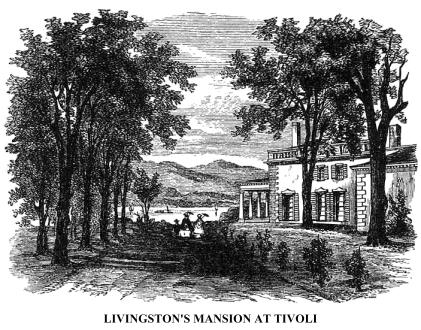
Tivoli is the mansion of John Swift Livingston, Esq., built before the war
for independence. It is surrounded by a pleasant park and gardens, and commands
a view of the village of Saugerties, on the west shore of the Hudson, and
that portion of the Katzbergs on which the Mountain House stands. That building
may be seen, as a white spot on the distant hills, in our sketch. Mr. Livingston's
house was occupied by one of that name when the British burnt Old Clermont
and the residence of the chancellor. They landed in De Koven's Cove, or Bay,
just below, and came up with destructive intent, supposing this to be the
residence of the arch offender. The proprietor was a good-humoured, hospitable
man. He soon convinced the invaders of their error, supplied them bountifully
with wine and other refreshments, and made them so kindly and cheery, that
had he been the "rebel" himself, they must have spared his property.
They passed on, performed their destructive errand, partook of the good things
of Mr. Livingston's larder and wine-cellar on their return, and sailed down
the river to apply the torch to Kingston, a few miles below.
At
Tivoli is the mansion of John Swift Livingston, Esq., built before the war
for independence. It is surrounded by a pleasant park and gardens, and commands
a view of the village of Saugerties, on the west shore of the Hudson, and
that portion of the Katzbergs on which the Mountain House stands. That building
may be seen, as a white spot on the distant hills, in our sketch. Mr. Livingston's
house was occupied by one of that name when the British burnt Old Clermont
and the residence of the chancellor. They landed in De Koven's Cove, or Bay,
just below, and came up with destructive intent, supposing this to be the
residence of the arch offender. The proprietor was a good-humoured, hospitable
man. He soon convinced the invaders of their error, supplied them bountifully
with wine and other refreshments, and made them so kindly and cheery, that
had he been the "rebel" himself, they must have spared his property.
They passed on, performed their destructive errand, partook of the good things
of Mr. Livingston's larder and wine-cellar on their return, and sailed down
the river to apply the torch to Kingston, a few miles below.
Opposite Tivoli, in Ulster County, is the pleasant village
of Saugerties, * near the mouth of the Esopus 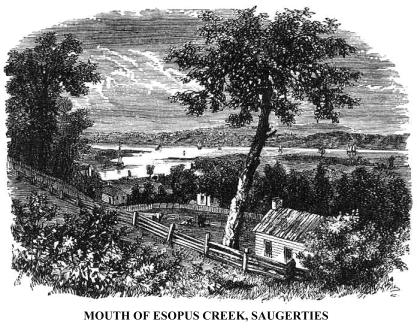 Creek,
which comes flowing from the south through a beautiful valley, and enters
the Hudson here. Iron, paper, and white-lead are manufactured there extensively,
and bet0000ween the river and the mountains are almost inexhaustible quarries
of flagging stone. A once picturesque fall or rapid, around which a portion
of the village is clustered, has been partially destroyed by a dam and unsightly
bridge above it, yet some features of grandeur and beauty remain. The chief
business part of the village lies upon a plain with the Katzbergs for a background,
and on the high right bank of the creek, where many of the first-class residences
are situated, an interesting view of the mouth of Zaeger's Kill, or Esopus
Creek, with the lighthouse, river, and the fertile lands on the eastern shore,
may be obtained. Near this village was the West Camp of the Palatines, already
mentioned.
Creek,
which comes flowing from the south through a beautiful valley, and enters
the Hudson here. Iron, paper, and white-lead are manufactured there extensively,
and bet0000ween the river and the mountains are almost inexhaustible quarries
of flagging stone. A once picturesque fall or rapid, around which a portion
of the village is clustered, has been partially destroyed by a dam and unsightly
bridge above it, yet some features of grandeur and beauty remain. The chief
business part of the village lies upon a plain with the Katzbergs for a background,
and on the high right bank of the creek, where many of the first-class residences
are situated, an interesting view of the mouth of Zaeger's Kill, or Esopus
Creek, with the lighthouse, river, and the fertile lands on the eastern shore,
may be obtained. Near this village was the West Camp of the Palatines, already
mentioned.
* Incorporated Ulster in 1831. The name is derived from the Dutch word Zaeger, a sawyer. Peter Pietersen having built a saw-mill at the Falls, where the village stands, the stream was called Sawyer's Creek, or zaeger's Kill, since, by corruption, Saugerties.
 About
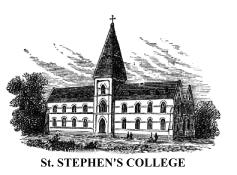
five miles below Tivoli is Annandale, the sent of John Bard, Esq. As we approached
it from the north on a pleasant day in June, along the picturesque road that
links almost a score of beautiful villas, the attention was suddenly arrested
by the appearance of an elegant little church, built of stone in the early
Anglo-Gothic style, standing on the verge of an open park. Near it was a long
building, in similar style of architecture, in course of erection. On inquiry,
we found the church to be that of the Holy Innocents, built by the proprietor
of Annandale upon his estate, for the use of the inhabitants of that region
as a free chapel. The new building was for St. Stephen's College, designed
as a training school for those who are preparing to enter the General Theological
Seminary of the Protestant Episcopal Church, in New York city. For this purpose
Mr. Bard had appropriated, as a gratuity, the munificent sum of 60,000 dollars.
He had deeded eighteen acres of land to the College, and pledged 1,000 dollars
a year for the support of a professor in it. The institution had been formally
recognized as the Diocesan Training College; the legislature of New York had
granted the trustees an act of incorporation, and liberal subscriptions had
been made to place it upon a stable foundation. In the midst of the grove
of fine old trees seen in the direction of the river bank from the road near
the College, stands the Villa of Annandale, like all its neighbors commanding
extensive river and mountain scenery.
About
five miles below Tivoli is Annandale, the sent of John Bard, Esq. As we approached
it from the north on a pleasant day in June, along the picturesque road that
links almost a score of beautiful villas, the attention was suddenly arrested
by the appearance of an elegant little church, built of stone in the early
Anglo-Gothic style, standing on the verge of an open park. Near it was a long
building, in similar style of architecture, in course of erection. On inquiry,
we found the church to be that of the Holy Innocents, built by the proprietor
of Annandale upon his estate, for the use of the inhabitants of that region
as a free chapel. The new building was for St. Stephen's College, designed
as a training school for those who are preparing to enter the General Theological
Seminary of the Protestant Episcopal Church, in New York city. For this purpose
Mr. Bard had appropriated, as a gratuity, the munificent sum of 60,000 dollars.
He had deeded eighteen acres of land to the College, and pledged 1,000 dollars
a year for the support of a professor in it. The institution had been formally
recognized as the Diocesan Training College; the legislature of New York had
granted the trustees an act of incorporation, and liberal subscriptions had
been made to place it upon a stable foundation. In the midst of the grove
of fine old trees seen in the direction of the river bank from the road near
the College, stands the Villa of Annandale, like all its neighbors commanding
extensive river and mountain scenery.
Adjoining Annandale on the south is Montgomery Place, the residence of the family of the late Edward Livingston, brother of the Chancellor, who is distinguished in the annals of his country as a leading United States senator, the author of the penal code of the State of Louisiana, and ambassador to France. The elegant mansion was built by the widow of General Richard Montgomery, a companion-in-arms of Wolfe when he fell at Quebec, and who perished under the walls of that city at the head of a storming party of Republicans on the 31st of December, 1775. Montgomery was one of the noblest and bravest men of his age. When he gave his young wife a parting kiss at the house of General Schuyler, at Saratoga, and hastened to join that officer at Ticonderoga, in the campaign that proved fatal to him, he said, "You shall never blush for your Montgomery." Gallantly did he vindicate that pledge. And when his virtues were extolled by Barré, Burke, and others in the British parliament, Lord North exclaimed, "Curse on his virtues; he has undone his country."
The wife of Montgomery was a sister of Chancellor Livingston.
With ample pecuniary means and good 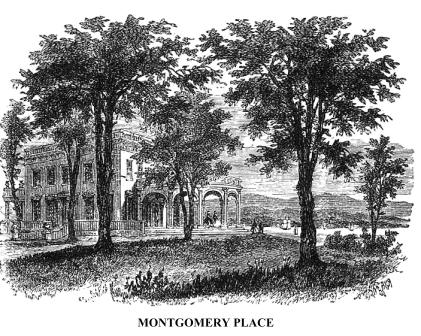 taste
at command, she built this mansion, and there spent fifty years of widowhood,
childless, but cheerful. The mansion and its 400 acres passed into the possession
of her brother Edward, and there, as we have observed, members of his family
now reside. Of all the fine estates along this portion of the Hudson, this
is said to be the most perfect in its beauty and arrangements. Waterfalls,
picturesque bridges, romantic glens, groves, a magnificent park, one of the
most beautiful of the ornamental gardens in this country, and views of the
river and mountains, unsurpassed, render Montgomery Place a retreat to be
coveted, even by the most favouréd of fortune.
taste
at command, she built this mansion, and there spent fifty years of widowhood,
childless, but cheerful. The mansion and its 400 acres passed into the possession
of her brother Edward, and there, as we have observed, members of his family
now reside. Of all the fine estates along this portion of the Hudson, this
is said to be the most perfect in its beauty and arrangements. Waterfalls,
picturesque bridges, romantic glens, groves, a magnificent park, one of the
most beautiful of the ornamental gardens in this country, and views of the
river and mountains, unsurpassed, render Montgomery Place a retreat to be
coveted, even by the most favouréd of fortune.
Four miles by the railway below Tivoli is the Barrytown Station,
or Lower Red Hook Landing. The villages of Upper and Lower Red Hook, like
most  of the
early towns along the Hudson, lie back from the river. Tivoli and Barrytown
are their respective ports. A short distance below the latter, connected by
a winding avenue with the public road already mentioned, is Rokeby, the sent
of William B. Astor, Esq., who is distinguished as the wealthiest man in the
United States. It was formerly the residence of his father-in-law, General
John Armstrong, an officer in the war for independence, and a member of General
Gates's military family. Armstrong was the author of the celebrated addresses
which were privately circulated among the officers of the Continental Army
lying at Newburgh, on the Hudson, at the close of the war, and calculated
to stir up a mutiny, and even a rebellion against the civil power. The feeble
Congress had been unable for a long time to provide for the pay of the soldiers
about to be disbanded and sent home in poverty and rags. There was apathy
in Congress and among the people on the subject; and these addresses were
intended to stir up the latter and their representatives to the performance
of their duty in making some provision for their faithful servants, rather
than to excite the army to take affairs into their own hand, as was charged.
Through the wisdom and firmness of Washington, the event was so overruled
as to give honour to the army and benefit the country. Washington afterwards
acquitted Major Armstrong of all evil intentions, and considered his injudicious
movement (instigated, it is supposed, by Gates) as a patriotic act.
of the
early towns along the Hudson, lie back from the river. Tivoli and Barrytown
are their respective ports. A short distance below the latter, connected by
a winding avenue with the public road already mentioned, is Rokeby, the sent
of William B. Astor, Esq., who is distinguished as the wealthiest man in the
United States. It was formerly the residence of his father-in-law, General
John Armstrong, an officer in the war for independence, and a member of General
Gates's military family. Armstrong was the author of the celebrated addresses
which were privately circulated among the officers of the Continental Army
lying at Newburgh, on the Hudson, at the close of the war, and calculated
to stir up a mutiny, and even a rebellion against the civil power. The feeble
Congress had been unable for a long time to provide for the pay of the soldiers
about to be disbanded and sent home in poverty and rags. There was apathy
in Congress and among the people on the subject; and these addresses were
intended to stir up the latter and their representatives to the performance
of their duty in making some provision for their faithful servants, rather
than to excite the army to take affairs into their own hand, as was charged.
Through the wisdom and firmness of Washington, the event was so overruled
as to give honour to the army and benefit the country. Washington afterwards
acquitted Major Armstrong of all evil intentions, and considered his injudicious
movement (instigated, it is supposed, by Gates) as a patriotic act.
Armstrong afterwards married a sister of Chancellor Livingston,
and was chosen successively to a seat 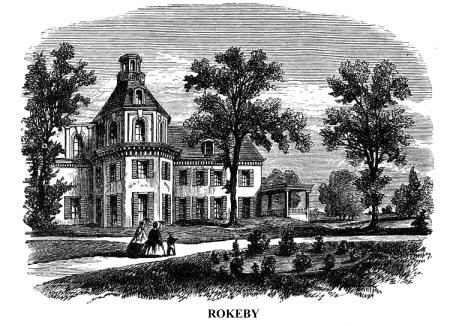 in
the United States senate, an ambassador to France, a brigadier-general in
the army, and secretary-of-war. He held the latter office while England and
the United States were at war, in 1812-14. He was the author of a "Life
of General Montgomery," "Life of General Wayne," and "Historical
Notices of the War of 1812." Rokeby, where this eminent man lived and
died, is delightfully situated, in the midst of an undulating park, farther
from the river than the other villas, but commanding some interesting glimpses
of it, with more distant landscapes and mountain scenery. Among the latter
may be seen the range of the Shawangunk (pronounced shon-gum), in the far
south-west. Here Mr. Astor's family reside about eight months of the year.
in
the United States senate, an ambassador to France, a brigadier-general in
the army, and secretary-of-war. He held the latter office while England and
the United States were at war, in 1812-14. He was the author of a "Life
of General Montgomery," "Life of General Wayne," and "Historical
Notices of the War of 1812." Rokeby, where this eminent man lived and
died, is delightfully situated, in the midst of an undulating park, farther
from the river than the other villas, but commanding some interesting glimpses
of it, with more distant landscapes and mountain scenery. Among the latter
may be seen the range of the Shawangunk (pronounced shon-gum), in the far
south-west. Here Mr. Astor's family reside about eight months of the year.
 A
few miles below Rokeby, and lying upon an elevated plain two miles from the
river, is the beautiful village of Rhinebeck, containing little more than
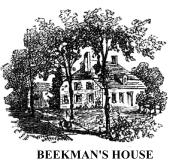
1,000 inhabitants. The first settler was William Beckman, or Beckman, who
came from the Rhine, in Germany, in 1647, purchased all this region from the
Indians, and gave homes to several poor families who came with him. The name
of the river in his fatherland, and his own, are commemorated in the title
of the town--Rhine-Beck. The house built by him is yet standing, upon a high
point near the Rhinebeck station. It is a stone building. The bricks of which
the chimney is constructed were imported from Holland: In this house the first
public religious services in that region were held, and it was used as a fortress
in early times, against the Indians. It now belongs to the Heermance family,
descendants of early settlers there. Beckman's son, Henry, afterwards procured
a patent from the English government for a very extensive tract of land in
Duchess County, including his Rhinebeck estate.
A
few miles below Rokeby, and lying upon an elevated plain two miles from the
river, is the beautiful village of Rhinebeck, containing little more than
1,000 inhabitants. The first settler was William Beckman, or Beckman, who
came from the Rhine, in Germany, in 1647, purchased all this region from the
Indians, and gave homes to several poor families who came with him. The name
of the river in his fatherland, and his own, are commemorated in the title
of the town--Rhine-Beck. The house built by him is yet standing, upon a high
point near the Rhinebeck station. It is a stone building. The bricks of which
the chimney is constructed were imported from Holland: In this house the first
public religious services in that region were held, and it was used as a fortress
in early times, against the Indians. It now belongs to the Heermance family,
descendants of early settlers there. Beckman's son, Henry, afterwards procured
a patent from the English government for a very extensive tract of land in
Duchess County, including his Rhinebeck estate.
Just below the Rhinebeck Station is Ellerslie, the seat of the
Hon. William Kelly. No point on the 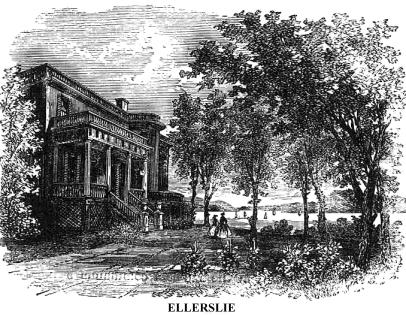 Hudson
commands a more interesting view of the river and adjacent scenery, than the
southern front of the mansion at Ellerslie. The house is at an elevation of
two hundred feet above the river, overlooking an extensive park. The river
is in full view for more than fourteen miles. At the distance of about thirty-five
miles are seen the Fish-Kill Mountains, and the Hudson Highlands, while on
the west, the horizon is bounded by the lofty Katzbergs.
Hudson
commands a more interesting view of the river and adjacent scenery, than the
southern front of the mansion at Ellerslie. The house is at an elevation of
two hundred feet above the river, overlooking an extensive park. The river
is in full view for more than fourteen miles. At the distance of about thirty-five
miles are seen the Fish-Kill Mountains, and the Hudson Highlands, while on
the west, the horizon is bounded by the lofty Katzbergs.
Ellerslie is ninety miles from New York city, and contains about seven hundred acres of land, with a front on the river of a mile and a-half. Its character is different from that of an ordinary villa residence, being cultivated with much care as a farm, whilst great regard is had to improving its beauty, and developing landscape effects. The lawn and gardens occupy thirty acres; the greenhouse, graperies &c., are among the most complete in this country. The park contains three hundred acres; its surface is undulated, with masses of old trees scattered over it, and upon it feeds a large herd of thorough-bred Durham cattle, which the proprietor considers a more appropriate ornament than would be a herd of deer.
A mile below Ellerslie is Wildercliff, * the seat of Miss Mary Garrettson, daughter of the eminent Methodist preacher, Freeborn Garrettson, who married a sister of Chancellor Livingston. The mansion is a very modest one, compared with some in its neighbourhood. It was built in accordance with the simple tastes of the original proprietor. Mr. Garrettson was a leader among the plain Methodists in the latter part of the last century, when that denomination was beginning to take fast hold upon the public mind in America, and his devoted, blameless life did much to commend his people to a public disposed to deride them.
* More properly Wilder Klippe. This is a Dutch word, signifying wild man's or wild Indian's, cliffe. The first settlers found upon a smooth rock, on the river shore, at this place, a rude delineation of two Indians, one with a tomahawk, and the other a calumet, or pipe of peace. This gave them the idea of the name.
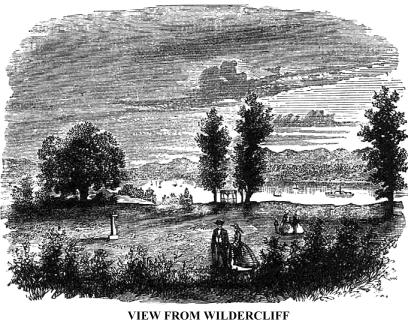 The
very beautiful view from this mansion, down the river, is exceedingly charming
for its simple beauty, so much in harmony with the associations of the place.
In the centre of the lawn stood a sun-dial. On the left was a magnificent
wide-spreading elm. On the right, through the trees, might be seen the cultivated
western shore of the Hudson, with the mountains beyond, and in front was the
river, stretching away southward, at all times dotted with the white sails
of water-craft. This mansion has many associations connected with the early
struggles of Methodism, very dear to the hearts of those who love that branch
of the Christian church.
The
very beautiful view from this mansion, down the river, is exceedingly charming
for its simple beauty, so much in harmony with the associations of the place.
In the centre of the lawn stood a sun-dial. On the left was a magnificent
wide-spreading elm. On the right, through the trees, might be seen the cultivated
western shore of the Hudson, with the mountains beyond, and in front was the
river, stretching away southward, at all times dotted with the white sails
of water-craft. This mansion has many associations connected with the early
struggles of Methodism, very dear to the hearts of those who love that branch
of the Christian church.
When Mr. Garrettson left the Church of England, in which he had been educated, the Methodists were despised in most places. He was a native of Maryland. Eminently conscientious, he gave his slaves their freedom, and entering upon his ministry, preached everywhere, on all occasions and at all times, offending the wicked and delighting the good, and fearless of all men, having full faith in a special Providence, and oftentimes experiencing proofs of the truth of the idea to which he clung. One example of his proofs may be cited. A mob had seized him on one occasion, and were taking him to prison by order of a magistrate, when a flash of lightning dispersed them, and they left him unmolested. In 1788 he was appointed Presiding Elder over the churches in the district, extending from Long Island Sound to Lake Champlain, more than two hundred miles. One of his converts was the daughter of Judge Livingston, of Clermont. Mr. Garrettson married her in 1793, and six years afterwards they built the mansion at Wildercliff. Probably no house in the world has ever held within it so many Methodist preachers as this, from the most humble of "weak vessels" up to Bishop Asbury, and other dignitaries of the church; for, with ample means at command, the doors of Mr. Garrettson and his wife were ever open to all, especially to their brethren in the ministry. And that generous hospitality is yet dispensed by the daughter, whose table is seldom without a guest.
Copyright © 1998, -- 2004. Berry Enterprises. All rights reserved. All items on the site are copyrighted. While we welcome you to use the information provided on this web site by copying it, or downloading it; this information is copyrighted and not to be reproduced for distribution, sale, or profit.