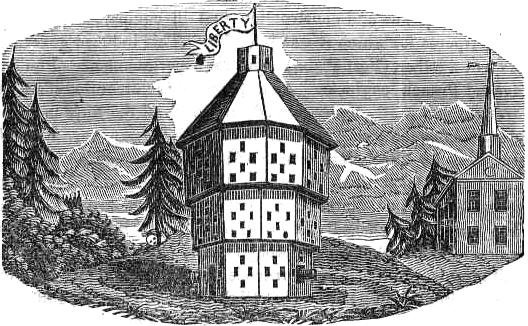
The Fort was
situated on the brow of the hill, about half a mile north-west of the village,
so as to command a full view of the valley, and the rise of the ground, for
several miles in any direction; and hence it doubtless derived its name, because,
its beautiful location commanded a "plain" view of the surrounding
country. It was erected by the government, as a fortress, and place of retreat
and safety for the inhabitants and families in case of incursions from the
Indians, who were then, and, indeed, more or less during the whole Revolutionary
war, infesting the settlements of this whole region. Its form was an octagon,
having port-holes for heavy ordonance and muskets on every side. It contained
three stories or apartments. The first story was thirty feet in diameter;
the se-
* Fort
Plank, as it is written in the books, was situated, two and a half miles from
Fort Plain. The true name was Fort Blank, from the name of the owner of the
farm on which it stood-Frederick Blank.
cond, forty feet;
the third, fifty feet; the last two stories projecting five feet, as represented
by the drawing aforesaid. It was constructed throughout of hewn timber about
fifteen inches square; and, beside the port-holes aforesaid, the second and
third stories had perpendicular port-holes through those parts that projected,
so as to afford the regulars and militia, or settlers garrisoned in the fort,
annoying facilities of defence for themselves, wives, and children, in case
of close assault from the relentless savage. Whenever scouts came in with
tidings that a hostile party was approaching, a cannon was fired from the
fort as a signal to flee to it for safety. In the early part of the war there
was built, by the inhabitants probably, at or near the site of the one above
described, a fortification, of materials and construction that ill comported
with the use and purposes for which it was intended. This induced government
to erect another, (Fort Plain,) under the superintendence of an experienced
French engineer. As a piece of architecture, it was well wrought and neatly
finished, and surpassed all the forts in that region. After the termination
of the Revolutionary war, Fort Plain was used for some years as a deposit
of military stores, under the direction of Captain B. Hudson. These stores
were finally ordered by the United States Government to be removed to Albany.
The fort is demolished. Nothing remains of it except a circumvallation or
trench, which, although nearly obliterated by the plough, still indicates
to the curious traveller sufficient evidence of a fortification in days by-gone.-
Fort Plain Journal, Dec. 26,1837.
No. II.
[REFERENCE FROM
PAGE 153.]
Copy of another paper in the same hand-writing, taken with the letter to General
Haldimand from Dr. Smith.
"April 20,1781.
" FORT STANWIX.
" THIS post is garrisoned by about two hundred and sixty men, under the
command of Colonel Courtlandt. It was supplied with provision about the 14th
of last month, and Brant was too early to hit their sleys ; he was there on
the 2d ; took sixteen prisoners. A nine-inch mortar is ordered from Albany
to this fort, to be supplied against the latter end of May; The nine months'
men raised are to join Courtlandt's.
" 25th May.--Fort
Stanwix is entirely consumed by fire, except two small bastions ; some say
by accident, but it is generally thought the soldiers done it on purpose,
as their allowance is short; provision stopped from going there, which was
on its way.
JOHN'S TOWN.
" At this
place there is a captain's guard.
" MOHAWK
RIVER.
" There
are no troops, or warlike preparations (as yet) making in this quarter; but
it is reported, that as soon as the three years and nine months' men are raised,
they will erect fortifications. From this place and its vicinage many families
have moved this winter, and it is thought more will follow the example this
spring.
" SCHENECTADY.
" This town
is strongly picketed all round ; has six pieces of ordnance, six pounders,
block-houses preparing. It is to be defended by the inhabitants ; (except
about a dozen) are for Government. There are a few of Courtlandt's regiment
here; a large quantity of grain stored here for the use of the troops ; large
boats building to convey heavy metal and shot to Fort Stanwix.
" ALBANY.
" No troops at this post, except the Commandant, General Clinton, and
his Brigade Major. Work of all kinds stopped for want of provisions and money.
The sick in the hospitals, and their doctors, starving. 8th May-No troops
yet in this place ; a fine time to bring it to submission, and carry off a
tribe of incendiaries.
" WASHINGTON'S
CAMP.
" The strength of this camp does not exceed twenty-five thousand. Provisions
of all kinds very scarce. Washington and the French have agents through the
country, buying wheat and flour. He has sent to Albany for all the cannon,
quick-match, &c., that was deposited there. Desertions daily from the
different posts. The flower of the army gone to the southward with the Marquis
De Lafayette.
" May 8th.
They say Washington is collecting troops fast.
" SOUTHERN
NEWS.
" On the 15th of March, Lord Cornwallis attacked General Green at Guilford
Court House, in North Carolina, and defeated him with the loss on Green's
side of thirteen hundred men killed, wounded, and missing ; his artillery,
and two ammunition wagons taken, and Generals Starns and Hegu wounded.
" May 20th.
Something very particular happened lately between here and New-York, much
in the King's favor, but the particulars, kept a secret.
" The inhabitants
between Albany and Boston, and several precincts, drink the King's health
publicly, and seem enchanted with the late proclamation from New-York. By
a person ten days ago from Rhode Island, we have an accounts that the number
of land forces belonging to the French does not amount to more than three
hundred ; that when he left it, he saw two of the French vessels from Chesapeake
much damaged and towed in; that several boats full of wounded were brought
and put into their hospitals, and that only three vessels out of the eight
which left the island escaped, the remainder brought into York. Out eastward
of Boston is acting on the Vermont principle.
" STATE
OF VERMONT.
" The opinion of the people in general of this State is, that its inhabitants
are artful and cunning, full of thrift and design. About fifteen days ago
Colonel Allen and a Mr. Fay was in Albany. I made it my particular business
to be twice in their company ; at which time I endeavored to find out their
business, and on inquiry I understood from Colonel Allen that he came down
to wait on Govenor Clinton, to receive his answer to a petition which the
people of Vermont had laid before the Assembly ; that he had been twice at
the Governor's lodging, and that the Governor had refused to see or speak
to him. Allen then said he might be damned if ever he would court his favor
again: since that time they have petitioned the Eastern States to be in their
Confederacy, to no purpose. I heard Allen declare to one Harper that there
was a North Pole and a South Pole; and should a thunder-gust come from the
south, they would shut the door opposite to that point and open the door facing
the north.
" 8th May.
By this time it is expected they will be friendly to their King ; various
opinions about their flag.
" SARATOGA.
" At this post there is a company belonging to Van Schaick's regiment,
lately come from Fort Edward; which garrison they left for want of provision;
and here they are determined not to stay for the same reason. A fort erecting
here by General Schuyler. Two hundred and fifty men at this place.
"FORT EDWARD.
"Evacuated. Now is the time to strike a blow in these parts. A party
toward Johnstown, by way of Division, and a considerable body down here, will
effect your wish.
GENERAL INTELLIGENCE.
" Norman's Kill, Nisquitha, Hillbarrack, and New Scotland, will immediately
on the arrival of his Majesty's troops, join and give provision. Several townships
east of Albany and south-east, are ready to do the like. Governor Trumbull's
son was hanged in London for a spy: he had several letters from Dr. Franklin
to some lords, which were found upon him.* No mention in the last Fishkill
papers that Greene obliged his Lordship to retreat, as has been reported.
The Cork fleet, of upward of one hundred sail, are safely arrived in York.
No hostile intentions on foot against the Province of Canada.
" May 25.
I just received a line from T. H. but before his arrival, I despatched a courier
on the point of a sharp weapon, to which I refer you ; and lest that should
miscarry, I send you my journal, from which, and the extract sent forward,
you may, if it arrives, form something interesting. For God's sake, send a
flag for me. My life is miserable. I have fair promises, but delays are dangerous."
With the above
was taken another paper in the same hand-writing, of which the following is
a copy :
" Y. H.
is disobedient, and neither regards or pays any respect to his parents : if
he did, he would contribute to their disquiet, by coming down contrary to
their approbation and repeated requests. "
" The necessaries
you require are gone forward last Tuesday by a person which the bearer will
inform you of. I wish he was in your company, and you all safely returned,
&c.
" My life
is miserable. A flag-a flag, and that immediately, is the sincere wish of
"H. SENIOR."
*
The reference here is to Colonel John Trumbull, the former Adjutant General
of the northern department, who, so far from having been hanged at the time
mentioned, is yet living, (Feb. 1838,) having served his country faithfully
and successfully in a high civil capacity since the war of the Revolution,
but, more to its glory still, by his contributions to the arts. It is true,
that at the time referred to by the writer of these memoranda, Colonel Trumbull
was in London. He had repaired thither to study the divine art which he has
so long and successfully cultivated, under the
instruction of his countryman, West, and with the tacit permission of the
British ministers. Owing, however, to the intrigues of some of the American
loyalists in London, who hated him bitterly, he was arrested in London during
the Autumn of 1780, on a charge of treason, and committed to the common prison.
He had a narrow escape, especially as great exasperation was kindled by the
execution of Andre, and it was hoped that an offset might be made in the person
of the son of a rebel Governor. West interceded with the King, and Trumbull
was liberated. Colonel Trumbull's Memoirs, which are in course of preparation,
will contain an interesting account of this affair, which was most disgraceful
to those who compassed his arrest.-Author.
No. III.
[REFERENCE FROM PAGE 165.]
1.
A FIRM fortress is our God, a good defence and weapon; He helps us free from
all our troubles which have now befallen us. The old evil enemy, he is now
seriously going to work; Great power and much cunning are his cruel equipments,
There is none like him on the earth.
2.
With our own strength nothing can be done, we are very soon lost: For us the
right man is fighting, whom God himself has chosen. Do you ask, who he is
? His name is Jesus Christ, The Lord Jehovah, and there is no other God ;
He must hold the field.
3.
And if the world were full of devils, ready to devour us, We are by no means
much afraid, for finally we must overcome The prince of this world, however
badly he may behave, He cannot injure us, and the reason is, because he is
judge ; A little word can lay him low.
4.
That word they shall suffer to remain, and not to be thanked for either: He
is with us in the field, with his Spirit and his gifts. If they take from
us body, property, honor, child and wife, Let them all be taken away, they
have yet no gain from it, The kingdom of heaven must remain to us.
[The above is
from a hymn book A. D. 1741. In one printed in 1826, and now in use in Pennsylvania,
the following is added:]
5.
Praise, honor and glory to the Highest God, the Father of all Mercy. Who has
given us out of love His Son, for the sake of our defects, Together with the
Holy Spirit. He calls us to the Kingdom : He takes away from us our sins,
and shows us the way to heaven ; May He joyfully aid us. Amen.
No. IV.
[REFERENCE FROM PAGE 167.]
Colonel Gansevoort's Address to the late 3d New- York Regiment. [Regimental
Orders.]
" Saratoga,
Dec. 30th, 1780.
"THE Colonel being by the new arrangement necessitated to quit the command
of his regiment, and intending to leave this post on the morrow, returns his
sincerest thanks to the officers and soldiers whom he has had the honor to
command, for the alacrity, cheerfulness, and zeal, which it affords him peculiar
satisfaction to declare they have so frequently evinced in the execution of
those duties which their stations required them to discharge, and for their
attention to his orders, which, as it ever merited, always had his warmest
approbation.
" Though
he confesses that it is with some degree of pain he reflects that the relation
in which they stood is dissolved, he will endeavor to submit without repining
to a circumstance which, though it may have a tendency to wound his feelings,
his fellow-citizens who form the councils of the states have declared would
be promotive of the public weal.
" In whatever
situation of life he may be placed, he will always with pleasure cherish the
remembrance of those deserving men who have with him been sharers of almost
every hardship incident to a military life. As he will now probably return
to that class of citizens whence his country's service at an early period
of the war drew him, he cordially wishes the day may not be very remote when
a happy peace will put them in the full enjoyment of those blessings for the
attainment of which they have nobly endured every inconvenience and braved
many dangers.
"P. GANSEVOORT."
An Address
to Colonel Peter Gansevoort, by the Officers of his Regiment, on his retiring
from service, in consequence of the new arrangement ordered by Congress.
" Saratoga,
Dec. 31, 1780.
" Sir,
" Permit us, who are now with reluctance separated from your command,
and deprived of the benefits which we frequently experienced therefrom, to
declare our sentiments with a warmth of affection and gratitude, inspired
by a consciousness of your unwearied attention to the welfare, honor, and
prosperity of the Third New York Regiment, while it was honored by your command.
" We should
have been peculiarly happy in your continuance with us. From our long experience
of your invariable attachment to the service of our country, your known and
approved abilities, and that affable and gentlemanlike deportment by which
(permit us to say) you have so endeared yourself to officers and soldiers,
that we cannot but consider the separation as a great misfortune.
" Although
your return to the class of citizens from whence our country's cause, at an
early period, called you, it is not a matter of choice in you, nor by any
means agreeable to us; yet it cannot but be pleasing to know that you retire
with the sincerest affection, and most cordial esteem and regards of the officers
and men you have commanded.
" We are,
with the utmost respect,
" Sir,
" Your most humble servants,
JAS. ROSEKRANS,
Major,
CORN'S. T. GANSEN, Captain,
J. GREGG, do,
LEONARD BLEEKER, do.
GEO. SYTEZ, do.
HENRY TIEBOUT, do,
HUNLOKE WOODRUFF, Surgeon,
J. VAN RENSSELAER, Paymaster,
DOUW T. FONDAY, Ensign,
B. BOGAEDUS, Lieutenant,
J. BAGLEY, do.
CHRS. HATTON, do.
W. MAGEE, do.
PRENTICE BOWEN, do.
SAML. LEWIS, do.
JOHN ELLIOT, Surgeon's Mate,
BENNJ. HERRING, Ensign,
GERRIT LANSING, do.
[REFERENCE FROM
PAGE 236.]
At a meeting of the principal inhabitants of the Mohawk District, in Tryon
County, Colonel JOSEPH THROOP in the Chair,
TAKING into consideration
the peculiar circumstances of this country, relating to its situation, and
the numbers that joined the enemy from among us, whose brutal barbarities
in their frequent visits to their old neighbours, are shocking to humanity
to relate :
They have murdered
the peaceful husbandman and his lovely boys about him, unarmed and defenceless
in the field. They have, with a malicious pleasure, butchered the aged and
inform ; they have wantonly sported with the lives of helpless women and children
; numbers they have scalped alive, shut them up in their houses, and burnt
them to death. Several children, by the vigilance of their friends, have been
snatched from flaming buildings; and, though tomahawked and scalped; are still
living among us; they have made more than three hundred widows, and above
two thousand orphans in this county ; they have killed thousands of cattle
and horses that rotted in the field ; they have burnt more than two millions
of bushels of grain, many hundreds of buildings, and vast stores of forage;
and now these merciless fiends are creeping in among us again, to claim the
privilege of fellow, citizens and demand a restitution of their forfeited
estates; but can they leave their infernal tempers behind them, and be safe
or peaceable neighbors ? Or can the disconsolate widow and the bereaved mother
reconcile her tender feelings to a free and cheerful neighborhood with those
who so inhumanly made her such ? Impossible! It is contrary to nature, the
first principle of which is self-preservation; it is contrary to the law of
nations, especially that nation, which, for numberless reasons, we should
be thought to pattern after. Since the accession of the House of Hanover to
the British throne, five hundred and twenty peerages in Scotland have been
sunk, the Peers executed or fled, and their estates confiscated to the crown,
for adhering to their former administration after a, new one was established
by law. It is contrary to the eternal rule of reason and rectitude. If Britain
employed them, let Britain pay them ! We will not.
Therefore, Resolved
unanimously, that all those who have gone off to the enemy, or have been banished
by any law of this state, or those who we shall find tarried as spies or tools
of the enemy, and encouraged and harbored those who went away, shall not live
in this district on any pretence whatever; and as for those who have washed
their faces from Indian paint, and their hands from the innocent blood of
our dear ones, and have returned either openly or covertly, we hereby warn
them to leave this district before the twentieth of June nest, or they may
expect to feel the just resentment of an injured and determined people.
We likewise unanimously
desire our brethren in the other districts in this county to join with us,
to instruct our representatives not to consent to the repealing any laws made
for the safety of the state, against treason or confiscation of traitors'
estates; or to passing any new acts for the return or restitution of Tories.
By order of the Meeting,
May 9, 1783. JOSIAH THROOP, Chairman.
At a meeting
of the freeholders and inhabitants of Canajoharie District, in the County
of Tryon, held at Fort Plain in the same district, on Saturday the 7th day
of June, 1783, the following resolves were unanimously entered into. Lieutenant
Colonel Samuel Clyde in the Chair :
Whereas,
In the course of the late war, large numbers of the inhabitants of this county,
lost to every sense of the duty they owed their country, have joined the enemies
of this state, and have, in conjunction with the British troops, waged war
on the people of this state; while others, more abandoned, have remained among
us, and have harbored, aided, assisted, and victualled the said British troops
and their adherents; and by their example and influence have encouraged many
to desert the service of their country, and by insults and threats have discouraged
the virtuous citizens, thereby inducing a number to abandon their estates
and the defence of their country: and whereas, the County of Tryon hath, in
an especial manner, been exposed to the continued inroads and incursions of
the enemy, in which inroads and incursions the most cruel murders, robberies,
and depredations have been committed that ever yet happened in this or any
other country ; neither sex nor age being spared, insomuch that the most aged
people of each sex, and infants at their mothers' breasts, have inhumanly
been butchered ; our buildings (the edifices dedicated to the service of Almighty
God not excepted) have been reduced to ashes; our property destroyed and carried
away; our people carried through a far and distant wilderness, into captivity
among savages (the dear and faithful allies of the merciful and humane British!)
where very many still remain, and have by ill usage been forced to enter into
their service.
And whereas,
Through the blessings of God and the smiles of indulgent Providence, the war
has happily terminated, and the freedom and independence of the United States
firmly established :
And whereas,
It is contrary to the interests of this county, as well as contrary to the
dictates of reason, that those persons who have, through the course of an
eight years' cruel war, been continually aiding and assisting the British
to destroy the liberties and freedom of America, should now be permitted to
return to, or remain in this county, and enjoy the blessings of those free
governments established at the expense of our blood and treasure, and which
they, by every unwarrantable means, have been constantly laboring to destroy,
Resolved,
That we will not suffer or permit any person or persons whatever, who have
during the course of the late war joined the enemy of this state, or such
person or persons remaining with is, and who have any ways aided, assisted,
victualled, or harbored the enemy, or such as have corresponded with them,
to return to, or remain in this district.
Resolved,
That all other persons of disaffected or equivocal character, who have by
their examples, insults, and threatenings, occasioned any desertions to the
enemy, or have induced any of the virtuous citizens of this county to abandon
their habitations, whereby they were brought to poverty and distress. And
all such as during the late war have been deemed dangerous, shall not be permitted
to continue in this district, or to return to it.
Resolved,
That all such persons now remaining in this district, and comprehended in
either of the above resolutions, shall depart the same within one month after
the publication of this.
Resolved,
That no person or persons, of any denominations whatever, shall be suffered
to come and reside in this district, unless such person or persons shall bring
with them sufficient vouchers of their moral characters, and of their full,
entire, and unequivocal attachment to the freedom and independence of the
United States.
Resolved,
That we will, and hereby do associate, under all the ties held sacred among
men and Christians, to stand to, abide by, and carry into full effect and
execution, all and every the foregoing resolutions.
Resolved,
That this district does hereby instruct the members in Senate and Assembly
of this state from this county, to the utmost of their power to oppose the
return of all such person or persons who are comprehended within the sense
and meaning of the above resolutions.
Ordered,
That the preceding votes and proceedings of this district be signed by the
Chairman, and published in the New York Gazetteer.
SAMUEL CLYDE, Chairman.
No. VI.
[REFERENCE FROM PAGE 288.]
" AT a meeting
of the President and Fellows of Harvard College, June 5th, 1789.
" Voted,
That the thanks of this Corporation be presented to Colonel Joseph Brant,
Chief of the Mohawk Nation, for his polite attention to this University, in
his kind donation to its library of the Book of Common Prayer of the Church
of England, with the Gospel of Mark, translated into the Mohawk language,
and a Primer in the same language.
" Attest,
JOSEPH WILLARD, President"
[REFERENCE FROM PAGE 312.]
SAINCLAIRE'S DEFEAT.
'Twas November the fourth, in year of ninety-one, We had a
sore engagement near to Fort Jefferson; Sinclaire was our commander, which
may remembered be, For there we left nine hundred men in t' West'n Ter'tory.
At Bunker's
Hill and Quebec, where many a hero fell, Likewise at Long Island, (it is I
the truth can tell,) But such a dreadful carnage may I never see again As
hap'ned near St. Mary's upon the river plain.
Our army was
attacked just as the day did dawn, And soon were overpowered and driven from
the lawn; They killed Major Ouldham, Levin, and Briggs likewise, And horrid
yell of savages resounded thro' the skies.
Major Butler
was wounded the very second fire; His manly bosom swell'd with rage when forc'd
to retire; And as he lay in anguish, nor scarcely could he see, Exclaimed,
" Ye hounds of hell, O! revenged I will be."
We had not been
long broken when General Butler found Himself so badly wounded, was forced
to quit the ground: " My God!" says he, " what shall we do
; we're wounded every man Go, charge them, valiant heroes, and beat them,
if you can."
He leaned his
back against a tree, and there resigned his breath, And like a valiant soldier
sunk in the arms of death; When blessed angels did await, his spirit to convey;
And unto the celestial fields he quickly bent his way.
We charg'd again
with courage firm, but soon again gave ground, The war-whoop then re-doubled,
as did the foes around; They killed Major Ferguson, which caused his men to
cry, " Our only safety is in flight, or fighting here to die."
Stand to your
guns," says valiant Ford, " let's die upon them there, Before we
let the sav'ges know we ever habored fear.'' Our cannon balls exhausted, and
artillery-men all slain, Obliged were our musket-men the en'my to sustain.
Yet three hours
more we fought them, and then were forc'd to yield, When three hundred bloody
warriors lay stretched upon the field. Says Colonel Gibson to his men, "
My boys, be not dismayed, ' I'm sure that true Virginians were never yet afraid.
"Ten thousand
deaths I'd rather die, than they should gain the field:" With that he
got a fatal shot, which caused him to yield. Says Major Clark, " My heroes,
I can here no longer stand, We'll strive to form in order, and retreat the
best we can."
The word 'Retreat'
being past around, there was a dismal cry Then helter-skelter through the
woods, like wolves and sheep they fly; This well-appointed army, who, but
a day before, Defied and braved all danger, had like a cloud pass'd o'er.
Alas! the dying
and wounded, how dreadful was the thought, To the tomahawk and scalping-knife,
in mis'ry are brought; Some had a thigh and some an arm broke on the field
that day, Who writhed in torments at the stake, to close the dire affray
To mention our
brave officers is what I wish to do; No sons of Mars e'er fought more brave,
or with more courage true. To Captain Bradford I belonged, in his artillery
; He fell that day amongst the slain, a valiant man was he.
No. VIII.
[REFERENCE FROM PAGE 314.]
Narrative of the Captivity and Sufferings of Massy Harbison, in the Spring
of 1792, who resided in the neighborhood of Pittsburgh, together with the
Murder of her children, her own escape, &c.
ON the return
of my husband from General St. Clair's defeat, mentioned in a preceding chapter,
and on his recovery from the wound he received in the battle, he was made
a spy, and ordered to the woods on duty, about the 28d of March, 1792. The
appointment of spies vol. II.
to watch the
movements of the savages was so consonant with the desires and interests of
the inhabitants, that the frontier now resumed the appearance of quiet and
confidence. Those who had for nearly a year been huddled together in the block-house
were scattered to their own habitations, and began the cultivation of their
farms. The spies saw nothing to alarm them, or to induce them to apprehend
danger, till the fatal morning of my captivity. They repeatedly came to our
house, to receive refreshments and to lodge.
On the 15th of
May, my husband, with Captain Giithrie and other spies, came home about dark,
and wanted supper ; to procure which I requested one of the spies to accompany
me to the spring and spring-house, and Mr. William Maxwell complied with my
request. While he was at the spring and spring-house, we both distinctly heard
a sound like the bleating of a lamb or fawn. This greatly alarmed us, and
induced us to make a hasty retreat into the house. Whether this was an Indian
decoy, or a warning of what I was to pass through, I am unable to determine.
But from this time and circumstance, I became considerably alarmed, and entreated
my husband to remove me to some more secure place from Indian cruelties. But
Providence had designed that I should become a victim to their rage, and that
mercy should be made manifest in my deliverance.
On the night
of the 21st of May, two of the spies, Mr. John Davis and Mr. Sutton, came
to lodge at our house, and on the morning of the 22d, at day-break, when the
horn blew at the block-house, which was within sight of our house, and distant
about two hundred yards, the two men got up and went out. I was also awake,
and saw the door open, and thought, when I was taken prisoner, that the scouts
had left it open. I intended to rise immediately ; but having a child at the
breast, and it being awakened, I lay with it at the breast to get it to sleep
again, and accidently fell asleep myself.
The spies have
since informed me that they returned to the house again, and found that I
was sleeping ; that they softly fastened the door, and went immediately to
the block-house ; and those who examined the house after the scene was over,
say both doors had the appearance of being broken open.
The first thing
I knew from falling asleep, was the Indians pulling me out of the bed by my
feet. I then looked up, and saw the house full of Indians, every one having
his gun in his left hand and tomahawk in his right. Beholding the dangerous
situation in which I was, I immediately jumped to the floor on my feet, with
the young child in my arms. I then took a petticoat to put on, having only
the one in which I slept; but the Indians took it from me, and as many as
I attempted to put on they succeeded in taking from me, so that I had to go
just as I had been in bed. While I was struggling with spine of the savages
for clothing, others of them went and took the two children out of another
bed, and immediately took the two feather beds to the door and emptied them.
The savages immediately began their work of plunder and devastation. What
they were unable to carry with them, they destroyed. While they were at their
work I made to the door, and succeeded in getting out, with one child in my
arms and another by my side ; but the other little boy was so much displeased
by being so early disturbed in the morning, that he would not come to the
door.
When I got out,
I saw Mr. Wolf, one of the soldiers, going to the spring for water, and beheld
two or three of the savages attempting to get between him and the block-house
; but Mr. Wolf was unconscious of his danger, for the savages had not yet
been discovered. I then gave a terrific scream, by which means Mr. Wolf discovered
his danger, and started to run for the block-house : seven or eight Indians
fired at him; but the only injury he received was a bullet in his arm, which
broke it. He succeeded in making his escape to the block-house. When I raised
the alarm, one of the Indians came up to me with his tomahawk, as though about
to take my life ; a second canoe and placed his hand before my mouth, and
told me to hush, when a third came with a lifted tomahawk, and attempted to
give me a blow; but the first that came raised his tomahawk and averted the
blow, and claimed me as his squaw.
The Commissary,
with his waiter, slept in the store-house near the block-house ; and upon
hearing the report of the guns, came to the door to see what was the matter,
and beholding the danger he was in made his escape to the block-house, but
not without being discovered by the Indians, several of whom fired at him,
and one of the bullets went through his handkerchief, which was tied about
his head, and took off some of his hair. The handkerchief, with several bullet
holes in it, he afterward gave to me.
The waiter, on
coming to the door, was met by the Indians, who fired upon him, and he received
two bullets through the body and fell dead by the door. The savages then set
up one of their tremendous and terrifying yells, and pushed forward, and attempted
to scalp the man they had killed ; but they were prevented from executing
their diabolical purpose by the heavy fire which was kept up through the port-holes
from the block-house.
In this scene
of horror and alarm I began to meditate an escape, and for that purpose I
attempted to direct the attention of the Indians from me, and to fix it on
the block-house; and thought if I could succeed in this, I would retreat to
a subterranean rock with which I was acquainted, which was in the run near
where we were. For this purpose I began to converse with some of those who
were near me respecting the strength of the block-house, the number of men
in it, &c., and being informed that there were forty men there, and that
they were excellent marksmen, they immediately came to the determination to
retreat, and for this purpose they ran to those who were besieging the block-house,
and brought them away. They then began to flog me with their wiping sticks,
and to order me along. Thus what I intended as the means of my escape, was
the means of accelerating my departure in the hands of the savages. But it
was no doubt ordered by a kind Providence, for the preservation of the fort
and the inhabitants in it; for when the savages gave up the attack and retreated,
some of the men in the house had the last load of ammunition in their guns,
and there was no possibility of procuring any more, for it wag all fastened
up in the store-house, which was inaccessible.
The Indians,
when they had flogged me away along with them, took my oldest boy, a lad about
five years of age, along with them, for he was still at the door by my side.
My middle little boy, who was about three years of age, had by this time obtained
a situation by the fire in the house, and was crying bitterly to me not to
go, and making bitter complaints of the depredations of the savages.
But these monsters
were not willing to let the child remain behind them: they took him by the
hand to drag him along with them, but he was so very unwilling to go, and
made such a noise by crying, that they took him up by the feet and dashed
his brains out against the threshold of the door. They then scalped and stabbed
him, and left him for dead. When I witnessed this inhuman butchery of my own
child, I gave a most indescribable and terrific scream, and felt a dimness
come over my eyes next to blindness, and my senses were nearly gone. The savages
then gave me a blow across my head and face, and brought me to my sight and
recollection again. During the whole of this agonizing scene I kept my infant
in my arms. As soon as their murder was effected, they marched me along to
the top of the bank, about forty-or sixty rods, and there they stopped and
divided the plunder which they had taken from our house; and here I counted
their number, and found them to be thirty-two, two of whom were white men
painted as Indians.
Several of the
Indians could speak English well. I knew several of them well, having seen
them go up and down the Alleghany river. I knew two of them to be from the
Seneca tribe of Indians, and two of them Munsees ; for they had called at
the shop to get their guns repaired, and I saw them there.
We went from
this place about forty rods, and they then caught Say uncle, John Carrie's
horses, and two of them, into whose custody I was put, started with me on
the horses, toward the mouth of the Kiskiminetas, and the rest of them went
off toward Puckety. When they came to the bank that descended toward the Alleghany,
the bank was so very steep, and there appeared so much danger in descending
it on horseback, that I threw myself off the horse in opposition to the will
and command of the savages.
My horse descended
without falling, but the one on which the Indian rode who had my little boy,
in descending, fell, and rolled over repeatedly; and my little boy fell back
over the horse, but was not materially injured. He was taken up by one of
the Indians, and we got to the bank of the river, where they had secreted
some bark canoes under the rocks, opposite to the island that lies between
the Kiskiminetas and Buffalo. They attempted in vain to make the horses take
the river. After trying some time to effect this, they left the horses behind
them, and took us in one of the canoes to the point of the island, and there
they left the canoe.
Here I beheld
another hard scene, for as soon as we landed, my little boy, who was still
mourning and lamenting about his little brother, and who complained that he
was injured by the fall in descending the bank, was murdered.
One of the Indians
ordered me along, probably that I should not see the horrid deed about to
be perpetrated. The other then took his tomahawk from his side, and with this
instrument of death killed and scalped him. When I beheld this second scene
of inhuman butchery, I fell to the ground senseless, with my infant in my
arms it being under, and its little hands in the hair of my head. How long
I remained in this state of insensibility, I know not.
The first thing
I remember was my raising my head from the ground, and my feeling myself exceedingly
overcome with sleep. I cast my eyes around, and saw the scalp of my dear little
boy, fresh bleeding from his head, in the hand of one of the savages, and
sunk down to the earth again upon my infant child. The first thing I remember
after witnessing this spectacle of woe, was the severe blows I was receiving
from the hands of the savages, though at that time I was unconscious of the
injury I was sustaining. After a severe castigation, they assisted me in getting
up, and supported me when up.
Here I cannot
help contemplating the peculiar interposition of Divine Providence in my behalf.
How easily might they have murdered me ! What a wonder their cruelty did not
lead them to effect it! But, instead of this, the scalp of my boy was hid
from my view and, in order to bring me to my senses again, they took me back
to the river and led me in knee deep ; this had its intended effect. But "
the tender mercies of the wicked are cruel."
We now proceeded
on our journey by crossing the island, and coming to a shallow place where
we could wade out, and so arrive to the Indian side of the country. Here they
pushed me in the river before them, and had to conduct me through it. The
water was up to my breast, but I suspended my child above the water, and,
through the assistance of the savages, got safely out.
From thence we
rapidly proceeded forward, and came to Big Buffalo ; here, the stream was
very rapid, and the Indians had again to assist me. When we had crossed this
creek, we made a straight course to the Connoquenessing creek, the very place
where Butler now stands; and from thence we travelled five or six miles to
Little Buffalo, and crossed it at the very place where Mr. B. Sarver's mill
now stands, and ascended the hill.
I now felt weary
of my life, and had a full determination to make the savages kill me, thinking
that death would be exceedingly welcome when compared with the fatigue, cruelties,
and miseries I had the prospect of enduring. To have my purpose effected,
I stood still, one of the savages being before me and the other walking on
behind me, and I took from off my shoulder a large powder horn they made me
carry, in addition to my child, who was one year and four days old. I threw
the horn on the ground, closed my eyes, and expected every moment to feel
the deadly tomahawk. But to my surprise the Indians took it up, cursed me
bitterly, and put it on my shoulder again. I took it off the second time,
and threw it on the ground, and again closed my eyes with the assurance that
I should meet death ; but, instead of this, the savages again took up the
horn, and with an indignant, frightful countenance, came and placed it on
again. I took it off the third time, and was determined to effect it; and
therefore threw it as far as I was able from me, over the rocks. The savage
immediately went after it, while the one who had claimed me as his squaw,
and who had stood and witnessed the transaction, came up to me, and said,
" well done, I did right, and was " a good squaw, and that the other
was a lazy son of a b-h ; he might "carry it himself." I cannot
now sufficiently admire the indulgent care of a gracious God, that at this
moment preserved me amidst so many temptations from the tomahawk and scalping
knife.
The savages now
changed their position, and the one who claimed me as his squaw went behind.
This movement, I believe, was to prevent the other from doing me any injury
; and we went on till we struck the Connequenessing at the Salt Lick, about
two miles above Butler, where was an Indian camp, where we arrived a little
before dark, having no refreshment during the day.
The camp was
made of stakes driven in the ground sloping, arid covered with chesnut bark,
and appeared sufficiently long for fifty men. The camp appeared to have been
occupied for some time; it was very much beaten, and large beaten paths went
out from it in different directions.
That night they
took me about three hundred yards from the camp, up a run, into a large dark
bottom, where they cut the brush in a thicket, and placed a blanket on the
ground, and permitted me to sit down with my child. They then pinioned my
arms back, only with a little liberty, so that it was with difficulty that
I managed my child. Here, in this dreary situation, without fire or refreshment,
having an infant to take care of and my arms bound behind me, and having a
savage on each side of me who had killed two of my dear children that day,
I had to pass the first night of my captivity.
Ye mothers, who
have never lost a child by an inhuman savage, or endured the almost indescribable
misery here related, may nevertheless think a little (though it be but little)
what I endured; and hence, now you are enjoying sweet repose and the comforts
of a peaceful and well-replenished habitation, sympathize with me a little,
as one who was a pioneer in the work of cultivation and civilization.
But the trials
and dangers of the day I had passed had so completely exhausted nature, that,
notwithstanding my unpleasant situation, and my determination, to escape if
possible, I insensibly fell asleep, and repeatedly dreamed of my escape and
safe arrival in Pittsburgh, and several things relating to the town, of which
I knew nothing at the time, but found to be true when I arrived there. The
first night passed away, and I found no means of escape, for the savages kept
watch the whole of the night, without any sleep.
In the morning,
one of them left us to watch the trail or path we had come, to see if any
white people were pursuing us. During the absence of the Indian, who was the
one that claimed me, the other, who remained with me, and who was the murderer
of my last boy, took from his bosom his scalp, and prepared a hoop and stretched
the scalp upon it. Those mothers who have not seen the like done by one of
the scalps of their own children, (and few, if any, ever had so much misery
to endure,) will be able to form but faint ideas of the feelings which then
harrowed up my soul! I meditated revenge. While he was in the very act, I
attempted to take his tomahawk, which hung by his side and rested on the ground,
and had nearly succeeded, and was, as I thought, about to give the fatal blow;
when, alas! I was detected.
The savage felt
me at his tomahawk handle, turned round upon me, cursed me, and told me I
was a Yankee; thus insinuating he understood my intention, and to prevent
me from doing so again, faced me. My excuse to him for handling his tomahawk
was, that my child wanted to play with the handle of it. Here again I wondered
at my merciful preservation, for the looks of the savage were terrific in
the extreme; and these, I apprehend, were only an index to his heart. But
God was my preserver.
The savage who
went upon the look-out in the morning came back about 12 o'clock, and had
discovered no pursuers. Then the one who had been guarding me went out on
the same errand. The savage who was now my guard began to examine me about
the white people, the strength of the armies going against them, &c.,
and boasted largely of their achievements in the preceding fall, at the defeat
of General St. Clair.
He then examined
into the plunder which he had brought from our house the day before. He found
my pocket-book and money in his plunder. There were ten dollars in silver,
and a half a guinea, in gold in the book. During this day they gave me a piece
of dry venison, about the bulk of an egg, and a piece about the same size
the day we were marching, for my support and that of my child; but owing to
the blows I had received from them in my jaws, I was unable to eat a bit of
it. I broke it up, and gave it to the child. The savage on the look-out returned
about dark. This evening, (Monday the 23d,) they moved me to another station
in the same valley, and secured me as they did the preceding night. Thus I
found myself the second night between two Indians, without fire or refreshment.
During this night I was frequently asleep, notwithstanding my unpleasant situation,
and as often dreamed of my arrival in Pittsburgh.
Early on the
morning of the 24th, a flock of mocking birds and robins hoverd over us, as
we lay in our uncomfortable bed, and sung, and said, at least to my imagination,
that I was to get up and go off. As soon as day broke, one of the Indians
went off again to watch the trail, as on the preceding day, and he who was
left to take care of me, appeared to be sleeping. When I perceived this, I
lay still and began to snore as though asleep, and he fell asleep.
Then I concluded
it was time to escape. I found it impossible to injure him for my child at
the breast, as I could not effect any thing without putting the child down,
and then it would cry and give the alarm; so I contented myself with taking
from a pillow-case of plunder, taken from our house, a short gown, handkerchief,
and The savage felt me at his tomahawk handle, turned round upon me, cursed
me, and told me I was a Yankee; thus insinuating he understood my intention,
and to prevent me from doing so again, faced me. My excuse to him for handling
his tomahawk was, that my child wanted to play with the handle of it. Here
again I wondered at my merciful preservation, for the looks of the savage
were terrific in the extreme; and these, I apprehend, were only an index to
his heart. But God was my preserver.
The savage who
went upon the look-out in the morning came back about 12 o'clock, and had
discovered no pursuers. Then the one who had been guarding me went out on
the same errand. The savage who was now my guard began to examine me about
the white people, the strength of the armies going against them, &c.,
and boasted largely of their achievements in the preceding fall, at the defeat
of General St. Clair.
He then examined
into the plunder which he had brought from our house the day before. He found
my pocket-book and money in his plunder. There were ten dollars in silver,
and a half a guinea; in gold in the book. During this day they gave me a piece
of dry venison, about the bulk of an egg, and a piece about the same size
the day we were marching, for my support and that of my child; but owing to
the blows I had received from them in my jaws, I was unable to eat a bit of
it. I broke it up, and gave it to the child. The savage on the look-out returned
about dark. This evening, (Monday the 23d,) they moved me to another station
in the same valley, and secured me as they did the preceding night. Thus I
found myself the second night between two Indians, without fire or refreshment.
During this night I was frequently asleep, notwithstanding my unpleasant situation,
and as often dreamed of my arrival in Pittsburgh.
Early on the
morning of the 24th, a flock of mocking birds and robins hoverd over us, as
we lay in our uncomfortable bed, and sung, and said, at least to my imagination,
that I was to get up and go off. As soon as day broke, one of the Indians
went off again to watch the trail, as on the preceding day, and he who was
left to take care of me, appeared to be sleeping. When I perceived this, I
lay still and began to snore as though asleep, and he fell asleep.
Then I concluded
it was time to escape. I found it impossible to injure him for my child at
the breast, as I could not effect any thing without putting the child down,
and then it would cry and give the alarm; so I contented myself with taking
from a pillow-case of plunder, taken from our house, a short gown, handkerchief,
and child's frock, and so made ray escape ; the sun then being about, half
an hour high.
I took a direction
from home, at first, being guided by the birds before mentioned, and in order
to deceive the Indians, then took over the hill, and struck the Connequenessing
creek about two miles from where I crossed it with the Indians, and went down
the stream till about two o'clock in the afternoon, over rocks, precipices,
thorns, briars, &c., with my bare feet and legs. I then discovered by
the sun, and the running of the stream, that I was on the wrong course, and
going from, instead of coming nearer home. I then changed my course, ascended
a hill, and sat down till sunset, and the evening star made its appearance,
when I discovered the way I should travel; and having marked out the direction
I intended to take the next morning, I collected some leaves, made up a bed
and laid myself down and slept, though my feet being full of thorns, began
to be very painful, and I had nothing still to eat for myself or child.
The next morning,
(Friday, 25th of May) about the breaking of the day I was aroused from my
slumbers by the flock of birds before mentioned, which still continued with
me, and having them to guide me through the wilderness. As soon as it was
sufficiently light for me to find my way, I started for the fourth day's trial
of hunger and fatigue.
There was nothing
very material occurred on this day while I was travelling, and I made the
best of my way, according to my knowledge, towards the Alleghany river. In
the evening, about the going down of the sun, a moderate rain came on, and
I began to prepare for my bed by collecting some leaves together, as I had
done the night before ; but could not collect a sufficient quantity without
setting my little boy on the ground ; but as soon as I put him out of my arms
he began to cry. Fearful of the consequence of his noise in this situation,
I took him in my arms, and put him to the breast immediately, and he became
quiet. I then stood and listened, and distinctly heard the footsteps of a
man coming after me in the same direction I had come! The ground over which
I had been travelling was good, and the mould was light; I had therefore left
my footmarks, and thus exposed myself to a second captivity ! Alarmed at my
perilous situation, I looked around for a place of safety, and providentially
discovered a large tree which had fallen, into the tops of which I crept,
with my child in my arms, and there hid myself securely under the limbs. The
darkness of the night greatly assisted me, and prevented me from detection.
The footsteps
I heard were those of a savage. He heard the cry of the child, and came to
the very spot where the child cried, and there he halted, put down his gun,
and was at this time so near that I heard the wiping stick strike against
his gun distinctly.
My getting in
under the tree, and sheltering myself from the rain, and pressing my boy to
my bosom, got him warm, and most providentially he fell asleep, and lay very
still during the time of my danger at that time. All was still and quiet,
the savage was listening if by possibility he might again hear the cry he
had heard before. My own heart was the only thing I feared, and that beat
so loud that I was apprehensive it would betray me. It is almost impossible
to conceive or to believe the wonderful effect my situation produced upon
my whole system.
After the savage
had stood and listened with nearly the stillness of death for two hours, the
sound of a bell, and a cry like that of a night-owl, signals which were given
to him from his savage companions, induced him to answer, and after he had
given a most horrid yell, which was calculated to harrow up my soul, he started,
and went off to join them.
After the retreat
of the savage to his companions, I concluded it unsafe to remain in my concealed
situation till morning, lest they should conclude upon a second search, and
being favored with the light of day, find me, and either tomahawk, or scalp
me, or otherwise bear me back to my captivity again, which was worse than
death.
But by this time
nature was nearly exhausted, and I found some difficulty in moving from my
situation that night; yet, compelled by necessity and a love of self-preservation,
I threw my coat about my child, and placed the end between my teeth, and with
one arm and my teeth I carried the child, and with the other arm groped my
way between the trees, and travelled on as I supposed a mile or two, and there
sat down at the root of a tree till the morning. The night was cold and wet;
and thus terminated the fourth day and night's difficulties, trials, hunger,
and danger.
The fifth day,
Saturday, 26th May, wet and exhausted, hungry and wretched, I started from
my resting-place in the morning as soon as I could see my way, and on that
morning struck the head waters of Pine Creek, which falls into the Alleghany
about four miles above Pittsburgh ; though I knew not then what waters they
were, but crossed them, and on the opposite bank I found a path, and discovered
in it two mockasin tracks, fresh indented, and the men who had made them were
before me, and travelling on the same direction that I was travelling. This
alarmed me ; but as they were before me, and travelling in the same direction
as I was, I concluded I could see them as soon as they could see me; and therefore
I pressed on in that path for about three miles, when I came to the forks
where another branch empties into the creek, and where was a hunter's camp,
where the two men, whose tracks I had before discovered and followed, had
been, and kindled a fire and breakfasted, and had left the fire burning.
I here became
more alarmed, and came to a determination to leave the path. I then ascended
a hill, and crossed a ridge toward Squaw run, and came upon a trail or path.
Here I stopped and meditated what to do; and while I was thus musing, 1 saw
three deers coming toward me in full speed ; they turned to look at their
pursuers ; I looked too with all attention, and saw the flash of a gun, and
then heard the report as soon as the gun was fired. I saw some dogs start
after them, and began to look about for a shelter, and immediately made for
a large log, and hid myself behind it; but most providentially I did not go
clear to the log; had I done so, I might have lost my life by the bites of
rattle-snakes; for as I put nay hand to the ground to raise myself, that I
might see what was become of the hunters and who they were, I saw a large
heap of rattle-snakes, and the top one was very large, and coiled up very
near my face, and quite ready to bite me. This compelled me to leave this
situation, let the consequences be what they might.
In consequence
of this occurrence, I again left my course, bearing to the left, and came
upon the head waters of Squaw run, and kept down the run the remainder of
that day.
During the day
it rained, and I was in a very deplorable situation ; so cold and shivering
were my limbs, that frequently, in opposition to all my struggles, I gave
an involuntary groan. I suffered intensely this day from hunger, though my
jaws were so far recovered from the injury they sustained from the blows of
the Indians, that wherever I could I procured grape vines, and chewed them
for a little sustenance. In the evening I came within one mile of the Alleghany
river, though I was ignorant of it at the time; and there, at the root of
a tree, through a most tremendous night's rain, I took up my fifth night's
lodgings; and in order to shelter my infant as much as possible, I placed
him in my lap, and placed my head against the tree, and thus let the rain
fall upon me.
On the sixth
(that was Sabbath) morning from my captivity, I found myself unable, for a
very considerable time, to raise myself from the ground ; and when I had once
more, by hard struggling, got myself upon my feet, and started upon the sixth
day's encounter, nature was so nearly exhausted, and my spirits were so completely
depressed, that my progress was amazingly slow and discouraging.
In this almost
helpless condition, I had not gone far before I came to a path where there
had been cattle travelling; I took the path, under the impression that it
would lead me to the abode of some white people, and by travelling it about
one mile, I came to an uninhabited cabin; and though I was in a river bottom,
yet I knew not where I was, nor yet on what river bank I had come. Here I
was seized with the feelings of despair, and under those feelings I went to
the threshold of the uninhabited cabin, and concluded that I would enter and
lie down and die; as death would have been to me an angel of mercy in such
a situation, and would have removed me from all my misery.
Such were my
feelings at this distressing moment, and had it not been for the recollection
of those sufferings which my infant would endure, who would survive for some
time after I was dead, I should have carried my determination into execution.
Here, too, I heard the sound of a cow-bell, which imparted a gleam of hope
to my desponding mind. I followed the sound of the bell till I came opposite
to the fort at the Six Mile Island.
When I came there,
I saw three men on the opposite bank of the river. My feelings at the sight
of these were better felt than described. I called to the men, but they seemed
unwilling to risk the danger of coming after me, and requested to know who
I was. I replied that I was one who had been taken prisoner by the Indians
on the Alleghany river on last Tuesday morning, and had made my escape from
them. They requested me to walk up the bank of the river for a while, that
they might see if the Indians were making a. decoy of me or not; but I replied
to them that my feet were so sore that I could not walk.
Then one of
them, James Closier, got into a canoe to fetch me over, and the other two
stood on the bank, with their rifles cocked, ready to fire on the Indians,
provided they were using me as a decoy. When Mr. Closier came near to the
shore, and saw my haggard and dejected situation, he exclaimed, " who,
in the name of God, are you ?" This man was one of my nearest neighbors
before I was taken ; yet in six days I was so much altered that he did not
know me, either by my voice or my countenance.
When I landed
on the inhabited side of the river, the people from the fort came running
out to the boat to see me : they took the child from me, and now I felt safe
from all danger, I found myself unable to move or to assist myself in any
degree: whereupon the people took me and carried me out of the boat to the
house of Mr. Cortus.
Here, when I
felt I was secure from the ravages and cruelties of the barbarians, for the
first time since my captivity my feelings returned with all their poignancy.
When I was dragged from my bed and from my home, a prisoner with the savages;
when the inhuman butchers dashed the brains of one of my dear children out
on the door-sill, and afterward scalped him before my eyes ; when they took
and tomahawked, scalped, and stabbed another of them before me on the island
; and when, with still more barbarous feelings, they afterward made a hoop,
and stretched his scalp on it; nor yet, when I endured hunger, cold, and nearly
nakedness, and at the same time my infant sucking my very blood to support
it, I never wept. No ! it was too, too much for nature. A tear then would
have been too great a luxury. And it is more than probable, that tears at
these seasons of distress would have been fatal in their consequences ; for
savages despise a tear. But now that my danger was removed, and I was delivered
from the pangs of the barbarians, the tears flowed freely, and imparted a
happiness beyond what I ever experienced before, or ever expect to experience
in this world.
When I was taken
into the house, having been so long from fire, and having endured so much
from hunger for a long period, the heat of the fire, and the smell of the
victuals, which the kindness of the people immediately induced them to provide
for me, caused me to faint. Some of the people attempted to restore me and
some of them put some clothes upon me. But the kindness of these friends would,
in all probability, have killed me, had it not been for the providential arrival
from down the river, of Major M'Culley, who then commanded the line along
the river. When he came in and saw my situation, and the provisions they were
making for me, he became greatly alarmed, and immediately ordered me out of
the house, from the heat and smell; prohibited my taking any thing but the
whey of buttermilk, and that in very small quantities, which he administered
with his own hands. Through this judicious management of my almost lost situation,
I was mercifully restored again to my senses, and very gradually to my health
and strength.
Two of the females,
Sarah Carter and Mary Ann Crozier, then began to take out the thorns from
my feet and legs; and Mr. Felix Negley, who now lives at the mouth of Bull
Creek, twenty miles above Pittsburgh, stood by and counted the thorns as the
women took them out, and there were one hundred and fifty drawn out, though
"they were not all extracted at that time, for the next evening, at Pittsburgh,
there were many more taken out. The flesh was mangled dreadfully, and the
skin and flesh were hanging in pieces on my feet and legs. The wounds were
not healed for a considerable time. Some of the thorns went through my feet
and came out on the top. For two weeks I was unable to put my feet to the
ground to walk.
Besides which,
the rain to which I was exposed by night, and the heat of the sun, to which
my almost naked body was exposed by day, together with my carrying my child
so long in my arms without any relief, and any shelter from the heat of the
day or the storms of the night, caused nearly all the skin of my body to come
off, so that my body was raw nearly all over.
The news of my
arrival at the station spread with great rapidity. The two spies took the
intelligence that evening as far as Coe's station, and the next morning to
Reed's station, to my husband.
As the intelligence
spread, the town of Pittsburgh, and the country for twenty miles round, way
all in a state of commotion. About sunset the same evening, my husband came
to see me in Pittsburgh, and I was taken back to Coe's station on Tuesday
morning. In the evening I gave the account of the murder of my boy on the
island. The next morning (Wednesday) there was a scout went out, and found
it by my direction, and buried it, after being murdered nine days.
Copy of a Letter
from Mr. JOHN CORBLY, a Baptist Minister, to his friend in Philadelphia, dated
Muddy Creek Penn, Sept. 1, 1792.
"DEAR Sir,
" The following
are the particulars! of the destruction of my unfortunate family by the savages
:- On the 10th May last, being my appointment to preach at one of my meeting
houses, about a mile from my dwelling-house, I set out with my loving wife
and five children for public worship. Not suspecting any danger, I walked
behind a few rods, with ray Bible in my hand, meditating. As I was thus employed,
on a sudden I was greatly alarmed by the shrieks of my dear family before
me. I immediately ran to their relief with all possible speed, vainly hunting
a club as I ran. When within a few yards of them, my poor wife observing me,
cried out to me to make my escape. At this instant an Indian ran up to shoot
me. I had to strip, and by so doing outran him. My wife had an infant in her
arms, which the Indians killed and scalped; After which they struck my wife
several times, but not bringing her to the ground, the Indian who attempted
to shoot me approached her, and shot her through the body ; after which they
scalped her. My little son, about six years old, they dispatched by sinking
their hatchets in his brains. My little daughter, four years old, they in
like manner tomahawked and scalped. My eldest daughter attempted an escape
by concealing herself in a hollow tree, about six rods from the fatal scene
of action. Observing the Indians retiring, as she supposed, she deliberately
crept from the place of her concealment, when one of the Indians, who yet
remained on the ground, espying her, ran up to her, and with his tomahawk
knocked down and scalped her. But, blessed be God, she yet survives, as does
her little sister whom the savages in the like manner tomahawked and scalped.
They are mangled to a shocking degree, but the doctors think there are some
hopes of their recovery.
" When I
supposed the Indians gone, I returned to see what had become of my unfortunate
family, whom, alas ! I found in the situation above described. No one, my
dear friend, can form a true conception of my feelings at this moment. A view
of a scene so shocking to humanity quite overcome me. I fainted, and was unconsciously
borne off by a friend, who at that instant arrived to my relief. " Thus,
dear sir, have I given you a faithful, though a short narrative of the fatal
catastrophe; amidst which my life is spared, but for what purpose the Great
Jehovah best knows. Oh, may I spend it to the praise and glory of His grace,
who worketh all things after the counsel of his own will. The government of
the world and the church is in his hands. I conclude with wishing you every
blessing, and subscribe myself your affectionate though afflicted friend,
and unworthy brother in the gospel ministry,
" JOHN CORBLY"
No. IX.
[REFERENCE FROM PAGE 376.]
Miamis Rapids, May 7th, 1794.
Two Deputies from the Three Nations of the Glaize arrived here yesterday,
with a speech from the Spaniards, brought by the Delawares residing near their
posts, which was repeated in a council held this day, to the following nations
now at this place, viz:-
Wyandots, Mingoes,
Ottawas, Munseys,
Chippawas, Nanticokes.
GRAND-CHILDREN
AND BRETHREN,
We are just arrived from the Spanish settlements upon the Mississippi, and
are come to inform you what they have said to us in a late council. These
are their words :
Children Delawares,
Six Strings White Wampum.
" Pointing
to this country." When you first came from that country to ask my protection,
and when you told me you had escaped from the heat of a great fire that was
like to scorch you to death, I took you by the hand and under my protection,
and told you to look about for a piece of land to hunt on and plant for the
support of yourselves and families in this country, which the Great Spirit
had given for our mutual benefit and support. I told you at the same time
that I would watch over it, and when any thing threatened us with danger,
that I would immediately speak to you ; and that when I did speak to you,
that it would behove you to be strong and listen to my words. Delivered six
Strings White Wampum.
The Spaniard
then, addressing himself to all the nations who were present, said,
CHILDREN, These
were my words to all the nations here present, as well as to your grand-fathers,
the Delawares. Now, Children, I have called you together to communicate to
you certain intelligence of a large force assembling on the Shawanoe river
to invade our country. It has given me very great satisfaction to observe
the strong confederacy formed among you, and I have no doubt of your ready
assistance to repel this force.
CHILDREN, You
see me now on my feet, and grasping the tomahawk to strike them.
CHILDREN, We
will strike them together. I do not desire you to go before me, in the front,
but to follow me. These people have too long disturbed our country, and have
extinguished many of our council-fires. They are but a trifling people compared
to the white people now combined against them, and determined to crush them
for their evil deeds. They must by this time be surrounded with enemies, as
all the white nations are against them. Your French Father also speaks through
me to you on this occasion, and tells you that those of his subjects who have
joined the Big-knives, are only a few of his disobedient children who have
joined the disobedient in this country ; but as we are strong and unanimous,
we hope, by the assistance of the Great Spirit, to put a stop to their mischievous
designs. Delivered a bunch Black Wampum.
CHILDREN, Now
I present you with a war-pipe, which has been sent in all our names to the
Musquakies, and all those nations who live toward the setting of the sun,
to get upon their feet and take hold of our tomahawk; and as soon as they
smoked it they sent it back, with a promise to get immediately on their feet
to join us and strike this enemy. Their particular answer to me was as follows
:
" FATHER,
We have long seen the designs of the Big-knives against our country, and also
of some of our own color, particularly the Kaskaskies, who have always spoke
with the same tongue as the Big-knives. They must not escape our revenge ;
nor must you, Father, endeavor to prevent our extirpating them. Two other
tribes of our color, the Piankishaws and the Cayaughkiaas, who have been strongly
attached to our enemies the Big-knives, shall share the same fate with the
Kaskaskies."
CHILDREN, You
hear what these distant nations have said to us, so that we have nothing farther
to do but put our designs in immediate execution, and to forward this pipe
to the three warlike nations who have so long been struggling for their country,
and who now sit at the Glaize. Tell them to smoke this pipe, and to forward
it to all the Lake Indians and their northern brethren ; then nothing will
be wanting to complete our general union from the rising to the setting of
the sun, and all nations will be ready to add strength to the blow we are
going to make. Delivered a War Pipe.
CHILDREN, I now
deliver you a Message from the Creeks, Cherokees, and Choctaws and Chickasaws,
who desire you to be strong in uniting yourselves; and tell you it has given
them pleasure to hear you have been so unanimous in listening to your Spanish
Father ; and they acquaint you that their hearts are joined to ours, and that
there are eleven nations of the southern Indians now on their feet, with the
hatchet in their hand, ready to strike our common enemy. Black Strings of
Wampum.
The Deputies
of the Three Nations of the Glaize, after speaking the above speeches from
the Spaniards, addressed themselves to the several nations in council, in
the following manner:
BROTHERS, You
have now heard the speeches brought to our council at the Glaize a few days
ago from the Spaniards, and as soon as they heard them and smoked the pipe,
their hearts were glad, and they determined to step forward and put into execution
the advice sent them. They desire you to forward the pipe, as has been recommended,
to all our northern brethren, not doubting but as soon as you have smoked
it, you will follow their example ; and they will hourly expect you to join
them, as it will not be many days before the nearness of our enemies will
give us an opportunity of striking them. Delivered the Pipe.
BROTHERS, Our
Grand-fathers, the Delawares, spoke first in our late council at the Glaize,
on this piece of painted tobacco and this painted Black Wampum, and expressed
their happiness at what they had heard from their Spanish Father and their
brethren to the Westward, and desired us to tell you to forward this tobacco
and Wampum to the Wyandots, to be sent to all the Lake Indians, and inform
them that in eight days they would be ready to go against the Virginians,
who are now so near us, and that according to the number of Indians collected,
they would either engage the army or attemptto cut off their supplies. The
Delawares also desired us to say to the Wyandots, that, as they are our elder
brethren, and took the lead
VOL. II. 37
in all our affairs
last summer, it was thought strange that none of them were now there to put
the resolution then formed into execution. It is true, some of them went last
Fall when it was thought too late, and the assembling of the nations put off
till spring ; but the spring is now far advanced, and none of them have yet
come. Delivered the Tobacco and Wampum.
Egouchouay answered
for all the nations present:-
BROTHERS, I am
happy at the good news you have told us, and
we will immediately go and collect all our people, and be with you as
soon as possible.
(Signed) A. McKee,
D. .A. I. A
A true copy, THOMAS TALBOT.
No.X.
[REFERENCE FROM PAGE 406.]
THE CHIEFS TO SIR JOHN JOHNSON.
"Grand River, Feb. 6, 1802.
" OUR DEAR FRIEND,
" We take
the opportunity of Moses Johnson's going to Canada, to trouble you with this
the easiest method that the distance of our situation from each other allows
of, to communicate our sentiments to you. We wish to acquaint you, that last
Fall, at our usual meeting at the beach, we made a speech to Captain Claus,
which he has not yet fully answered. It was principally respecting the letter
you wrote to Captain Brant, when you was at Niagara last summer, which we
were sorry to find so severe; and as we are sensible that be has never attempted
any thing to the detriment of the British interest, we were much surprised
to find that his conduct seemed to give umbrage there. As to the uneasiness
you mentioned prevailed at Grand River, we are entirely ignorant of any such
thing among us who manage the affairs of the tribes living here ; and as he
is our appointed agent, he yet never acts without our approbation in whatever
regards the public; consequently, if any of his transactions have given offence,
we are all equally culpable. Therefore, if customs are so much changed with
you, that the following the tracks of our predecessor gives umbrage, we hope,
from our ancient friendship, you will inform us wherein it injures the interests
of our brethren, for then our regard for their welfare will cause us to desist;
and if there is a change in politics, don't let us remain ignorant of it;
for ignorance might cause us unwittingly to give offence. As you know that
not long ago a friendly correspondence and union with the different nations
seemed to give pleasure to our brothers, we yet remain of the same sentiments,
for we could not lightly drop what we took so much pains to begin; and we
can yet hardly persuade ourselves that you have changed your sentiments; but
if it is the case, we hope you will do us the favor fully to acquaint us,
that we may not be liable to give uneasiness where we really mean none.
"I have the honor to be
" Your
humble and most obed't servt.,
(Signed)
"AARON HILL.
"In behalf of the Chiefs of the Mo-
hawk, Oghkwaga, Onondaga, Cayuga,
and Seneca Nations, living on the
Grand River."
No. XI.
[REFERENCE FROM PAGE 411.]
GOVERNOR CLINTON TO CAPTAIN BRANT.
" Greenwich, 1st December, 1799.
"DEAR SIR,
" On my
return from the country about a month ago, I was favored with your letter
of the 4th of September. I am much gratified by the determination you express
of furnishing Doctor Miller with the information he requested of you, and
I hope, as the work for which it is wanted is progressing, you will find leisure
to do it soon. I am confident he will make a fair and honorable use of it
; and, as far as he shall be enabled, correct the erroneous representations
of former authors respecting your nations.
" I am surprised
to find that you have not received my answer to your letter of the 11th January
last. It was inclosed and forwarded as requested, to Mr. Peter W. Yates of
Albany. Had it reached you, I presume you will find, from the copy I now inclose,
it would have been satisfactory; but as a particular detail of what passed
between the Coghnawagoes and me, respecting their lands, may be more agreeable,
I will now repeat it to you as far as my recollection will enable me :-
" In the
Winter of 1792-1793, our Legislature being in session in Albany, a committee
from the seven nations or tribes of Lower Canada attended there, with whom
I had several conferences. They complained that some of our people had settled
on their lands near Lake Champlain and on the River St. Lawrence, and requested
that Commissioners might be appointed to inquire into the matter, and treat
with them on the subject. In my answer to their speeches I mentioned that
it was difficult to define their rights and their boundaries ; that it was
to be presumed that the Indian rights to a considerable part of the lands
on the borders of the lake had been extinguished by the French Government
before the conquest of Canada, as those lands, or the greater part of them,
had been granted to individuals by that government before that period. In
their reply, they described their southern boundary as commencing at a creek
or run of water between Forts Edward and George, which empties into South
Bay, and from thence extending on a direct line to a large meadow or swamp,
where the Canada Creek, which empties into the Mohawk opposite Fort Hendrick,
the Black and Oswegatchie Rivers have their sources. Upon which I observed
to them that this line would interfere with lands patented by the British
Government previous to the Revolution, and particularly mentioned Totten and
Crossfield's purchase and Jessup's patent; but I mentioned, at the same time,
that I was neither authorised nor disposed to controvert their claims, which
I would submit to the Legislature, who I could not doubt would pay due attention
to them, and adopt proper measures to effect a settlement with them upon fair
and liberal terms. This I accordingly did ; and some time after Commissioners
were appointed to treat with them in the presence of an agent of the United
States, the result of which I find you are informed of.
" I believe
you will readily agree that no inference could be drawn from any thing that
passed on the above occasion to countenance the charge made against your nations.
The mentioning and interference of their boundaries, as above stated, with
tracts patented under the British Colonial Government, could certainly have
no allusion to the cessions made by the Six Nations, or either of them, to
the state; especially as (if I recollect right) those cessions are of the
territory of the respective nations by whom they were made without defining
them by any particular boundaries, and subject only to the reservations described
in the deed.
" I wish
it was in my power to transmit you copies of their speeches and my answers
at full length ; but it is not, for the reasons mentioned in my former letter.
Should they, however, be deemed necessary by you, I will endeavor to procure
and forward them. In the meantime you may rest assured that what I have above
related is the substance of them.
" I am, with great regard and esteem,
" Your most obed't servant,
" GEO. CLINTON.
" Col. Joseph Brant."
NO.XII.
[REFERENCE FROM
PAGE 416.]
CERTIFICATE OF GENERAL CHAPIN.
I CERTIFY I have been personally acquainted with Captain Joseph Brant for
fourteen years past; that during this time have frequently been with him in
treaties and councils held between the people of the United States and the
Five Nations of Indians. That during the time aforesaid, my father, Israel
Chapin, Esq. held the office of Indian affairs for the Five Nations of Indians,
under the President of the United States; and during his agency, Captain Brant
was several times in the States in transacting business of importance. At
one time, in particular, he was invited to the seat of Government of the United
States for the purpose of consulting upon means for restoring the Indians
then hostile to the United States to a general peace; which visit occasioned
some suspicions and censures against Captain Brant by certain characters residing
in the province where he belonged. That, through the instigation of certain
persons, jealousies have arisen, not only among some white people, but among
his own also. That the jealousies of his own people are easily awakened; and
solely upon this ground they have proceeded in the Indian forms to disown
him as a Chief. That the Seneca Indians, with some others residing within
the territory of the United States, who have had the disposal of a considerable
part of the Five Nations' lands, and have sold, and do actually receive annuities
from the people of the United States annually for the same, have been the
principal actors in deposing him. That after the death of my father I succeeded
him in the office, as aforesaid, and during my own agency had frequent meetings
with Captain Brant in Indian councils, &c. And I do further certify, that
during the whole of my acquaintance with Captain Brant, he has conducted himself
with honor and integrity. That, so far from conducting himself in secrecy,
or in any way inclining to alienate himself from the British government, or
in doing any thing that might be prejudicial to the Indians ; on the other
hand, he has frankly avowed that he would strenuously adhere to the Government
and interest of the people to which he belonged ; that his honor and friendship
for the Indian nations were so near his heart, that nothing should occasion
him to do any thing incompatible with his duty ; and that his own time and
trouble have been expended and greatly prolonged in doing every thing in his
power to promote the interest of his nation and those allied to them. And
Captain Brant having called on me to certify my opinion as aforesaid, I am
free to declare to any who may be concerned, that from a long and intimate
acquaintance I have good reason to make the remarks as aforesaid.
ISRAEL CHAPIN,
Agent of Indian Affairs for the, Five Nations.
Canandaigua, in the western part of the
State of N,.Y., Oct. 28th, 1805.
No. XIII.
[REFERENCE FROM PAGE 417.]
CERTIFICATE OF CAPTAIN LEONARD AND OTHERS.
WE, the subscribers, certify, that in the month of April last there came to
Fort Niagara about forty Seneca Indians, among whom were the Farmer's Brother,
Red Jacket, Jack Berry, and other Chiefs. While at Niagara, detained by ice,
we heard them say in public and private conversation, that they were going
into Upper Canada for the express purpose of breaking Captain Brant, a Mohawk
Chief. We also certify that the Seneca Chiefs above named reside within the
United States.
Given under our
hands at Fort Niagara, this 20th day of October 1805.
W. LEONARD, Capt.
U. S. Artillery,
G. ARMISTEAD, Lieut. U. S. Artillery.
H. M. ALLEN, Lieut. U. S. Artillery,
ROBERT LEE, Col. of the Revenue.
No. XIV.
[REFERENCE FROM PAGE 418.]
PROCEEDINGS of a Council held at the Grand River, the 29th day of June, 1804,
with the Six Nations, viz : Mohawks, Oneydas, Onondagas, Cayougas, Senecas,
and Tuscaroras ; and the following Nations,-Tutulies, Delawares, and Nanticokes.
Present,
Lieut. Col. Brock, 49th Reg't. Commanding,
William Claus, Esq., Dept'y Sup't Gen. of Indian Affairs.
James Gwins, Esq., Agent of Indian Affairs.
Lieut, Cary, 49th Regiment.
Lieut. Stretton, 49th Regiment.
William Dickson, Esq.
Richard Beasley, Esq.
Alexander Stewart, Esq.
Mr. W. I. Chew, Store-keeper and Clerk Indian Dep
Benj. Fairchild,
J. B. Rousseau, Interpreters Indian Dep.
The Deputy Superintendent
General addressed the Chiefs as follows:-
BRETHREN, It
gives me great satisfaction to meet you at this place, and in presence of
so many of the King's officers and others this day, to renew our assurances
of friendship, which I hope will continue uninterrupted as long as the waters
run.
I dispel the
darkness which hangs over you by reason of your many losses. I most heartily
wish you may enjoy a serene and clear sky; so that you may be able to see
your brethren from the sun-rising to the sun-setting.
BRETHREN, I must
admonish and exhort you that you will at all times, but more especially at
this juncture, pluck from your hearts and cast away all discords, jealousies,
and misunderstandings which may subsist among you, or which any evil spirits
may endeavor to raise in your breasts.
I therefore,
with this Wampum, make this Council-room clean from every thing offensive,
and hope that you will take care that no snake may creep in among us, or any
thing that may obstruct our harmony. Bunch of Wampum.
BRETHREN, I have
but a few words to speak, as the fewer that is said the easier you will understand
and comprehend. Last year, about the time your corn was getting hard, I had
the pleasure of seeing you at the King, your Great Father's council-fire at
Niagara. I then addressed you on the business of your land transactions. I
informed you then that General Hunter had taken your affairs into his most
deliberate consideration, and what the result of those considerations were.
Since that time
some people have come forward to pay for the township which was sold to Mr.
Beasley and his associates ; and the only thing which now remains upon the
minds of your trustees, and which they cannot answer for, (unless you, in
the most public manner, express your satisfaction,) is the statement made
by Mr. Beasley of monies said to have been paid on your account to your agent.
Captain Brant.
I will here explain
to you the sums said to have been paid ; and if you are satisfied, the necessary
discharges will then be given, and your business, I hope, carried on in future
more to your satisfaction, and also of the others concerned.
BRETHREN, The
following sums are stated by Mr. Beasley to have been paid by him, and boards
delivered by his order.
[Here follows
the statement of the pecuniary transactions of Captain Brant, as the agent
of the Mohawk Nation, which there is no occasion to transcribe in this place.]
If you wish to
consult among yourselves before you give your answer, as I wish you to do,
I shall wait until you are ready, as it is necessary that this business should
come to a close; but do not let us hurry, take time and weigh the matter well;
if you are satisfied that the statement of the account is just, I will lay
before you a paper to sign, which shall be explained to you, that you may
perfectly comprehend and understand it.
I must farther
inform you, that I hope every man that attends for the purpose of executing
the above papers may keep from liquor, as I am determined no name shall appear
there, unless the whole council are perfectly sober.
Before we cover
the fire to-day, I must inform you that the King's Council, with the approbation
of General Hunter, have given themselves a great deal of pains in inquiring
and seeing that justice should be done to the Six Nations in this business,
for which I am confident you will acknowledge yourselves sensible.
I have further
to mention to you, that the Governor in Council have thought it for the advantage,
benefit, and interest of the Six Nations, that Sir John Johnson should be
added as a Trustee for the Six Nations, but it is left for you to consider
and say whether he is, or is not to be added to those who are now acting for
you.
I shall now retire,
and when you have finished consulting, I shall be ready to attend you. [Large
Bunch of Wampum.]
30th June. Present the same as yesterday.
I am much pleased
that you have so clearly comprehended what I said to you yesterday, and as
you are unanimously agreed to admit of the account as just, the following
is the paper which it will be necessary for your principal people to sign
; but before I go further, I must tell you that your expressions of friendship
for me draws from me the warmest sense of Ceding. I shall ever endeavor to
preserve your esteem and regard, and you may rest assured that my constant
exertions shall be for your interest and happiness.
We, the Sachems
and principal War Chiefs, Warriors, and principal women of the Six Nations,
having taken into mature consideration the said account, and having examined
the several items and entries therein, and the whole having been explained
to us in the fullest manner, declare that we perfectly understand and comprehend
the same ; do hereby unanimously approve thereof as just and true; and do
fully admit and acknowledge that the several sums of money set down and charged
in the said account as payments made by Mr. Beasley, to and for the use of
the Six Nations, were really and truly made; and that the boards and materials
charged in the same accounts were actually furnished by Mr. Beasley, also
to and for the use of the Six Nations.
In testimony
whereof, the aforesaid Sachems, principal War Chiefs, Warriors, and principal
Women of the Six Nations, in behalf of the Body of the said Six Nations, have
to these presents (done in tripulate) set our hands and affixed our seals
at the Council House at the Mohawk Village on the Grand River, this 80th day
of June, in the year of our Lord, 1804, and forty-fourth year of his Majesty's
reign.
All of these
indicate "his mark"
Tekarihoken
Gonesseronton
Thaweyogearat
Shagogeaseronni
Oghnaongoghton
Ojageghte
Otoghseronge
Waorighonti
Aonghwinjaga
Tekaenyongh
Otyoghwawagon
Ogongksaneyont
Aghstugwaresera
Thaosonnenghton
Tekahentakwa
Teghsitaasgowa
Oghsonwalagette
Arenghoot
Yoghstatheagh
Nihaweanaagh
Araghkwente
Karrhageayate
Oghgwarioghseta
Kaweanontye
We do certify
that the within proceedings were held in our presence, and that the accounts
and different items were explained to the Sachems, War Chiefs, and principal
Women under the direction of the Deputy Superintendent General of Indian Affairs
; that they seemed perfectly to understand and comprehend the same, and acknowledged
that they did so, and were perfectly satisfied therewith. We do also certify
that those whose names, marks, and seals are hereunto affixed, as well as
the whole Council, were perfectly sober when they-executed the within.
Council Room,
Grand River, 30th June, 1804.
ISAAC BROCK, Col. 49th Regt. Commissioners.
WILLIAM CAREY, Lieut. 49th Regt.
WILLIAM STRATTON, Lieut. 49th Regt.
After finishing, the usual ceremony of taking leave was gone through, and
[A large bunch of Wampum delivered.]
No. XV.
[REFERENCE FROM PAGE 423.]
COUNCIL HELD AT NIAGARA.
[THIS speech was made by Capt. Brant at Niagara to Col. William Claus, Deputy
Superintendent General of Indian affairs-after John Norton, alias Teyoninhokarawen,
had returned from England, who had been sent there by Capt. Brant.
W. J. KERR.]
BROTHER,-We have
now come to this place, the Council-fire of our Great Father the King, to
explain, in a public manner, the foundation of our claim to the lands we now
possess, the attempts made in this country to curtail and invalidate our title
to them, and latterly the means taken to obstruct the just decision of his
Majesty's Eight Honorable Privy Council on the subject.
BROTHER,-In the
year 1775, when hostilities had commenced, the Mohawks, always faithful to
the royal interest, brought off the Indian Department, in company with the
Oghkuagas, from the Mohawk River to Canada. Upon our arrival there, this conduct
was approved of by Sir Guy Carleton, who, in a public Council, desired us
to take up the hatchet and defend our country, and that any losses we might
sustain by the war, he promised should be replaced.
When the support
given the Americans by the various European powers gave us reason to apprehend,
that the war might take such an unfavorable conclusion as to deprive us of
the happiness of return to our homes, and to the re-enjoyment of our forsaken
lands, we applied to Sir Frederick Haldimand, then Governor and Commander-in-Chief,
for a confirmation of General Carleton's promise ; this he readily granted
us, and we have it now in our possession. When the line drawn at the peace,
and the manner in which that was concluded, left us no hopes of regaining
our former possessions, we applied to His Excellency Sir Frederick Haldimand
for it grant is the Bay of Quinte.
On this becoming
known to the Senecas and others at Buffalo Creek, they upbraided us with having
treated them unfairly, after having been the most forward to engage in the
royal cause, and having drawn them into the contest, now to abandon them in
the present critical situation, to be exposed alone to such retaliation as
revenge might urge the Americans to attempt.
We were struck
with the justness of their argument, and in consequence relinquished the place
we had first chosen, and applied for the Grand River in lieu of it; as there
being more conveniently situated either to give assistance to our brethren,
if assistance was wanted, or to afford them a comfortable asylum should superior
numbers oblige them to retreat. His Excellency expressed his satisfaction
at our determination, and the terms of his grant will confirm the accuracy
of this assertion.
In a little time
the Senecas were relieved from their apprehensions, they remained on their
lands, and sold them gradually to the Americans; for which they receive annually
six thousand five hundred dollars, besides four thousand five hundred dollars
which they get in common with others of the Six Nations inhabiting within
the territories of the United States, from whom also several of their Chiefs
receive pensions ; with these arrangements they have appeared to remain contented
on the reserves they have retained.
General Haldimand
was on the eve of embarking for Europe when he executed the grant. This we
may suppose to have been the reason why it was not registered at Quebec ;
and from this circumstance, shortly after the formation of the Canadian government,
an attempt, was made to curtail our land.
After we came
to a proper understanding on this head, from the consideration that the animals
were becoming scarce for the hunters, we proposed leasing a part of our lands,
not in our power to occupy, to receive therefrom an annual income ; the leasing
was objected to by the Executive, but they were sold with the sanction of
the Canadian Government, and mortgaged for the payment of the interest; the
incumbrances, however, annexed to these arrangements, have prevented us as
yet deriving the benefit therefrom we had reason to expect.
We have asked
for a confirmation of the remaining lands, that our posterity might enjoy
in security the benefits of our industry, and of their own; but this request
has never yet met with an answer.
What we asked
for, seemed to be of such a nature as not to render it necessary to apply
to higher authority than there was in this country, (providing the inclination
should be favorable to grant us our requests,) was the reason we persevered
in entreating for a satisfactory decision of the Executive for many years
; notwithstanding repeated retardments in our business, we were reluctant
to trouble his Majesty's Government in Britain with so trifling an affair.
However, at the
time my nephew Teyoninhokarawen desired to go to Europe to serve in the war,
We hoped, should an opportunity occur for him to make representation of our
situation, it might expedite the conclusion of the business to our satisfaction.
This he was well enabled to do from his knowledge of the subject, and authorized
as being an adopted Chief: as such, I gave him letters of introduction to
my friends there; and from the generosity and love of justice, which ever
distinguishes his Majesty's Government, and is peculiarly prevalent in the
British nation, it appears he was attended to, and in consequence of his representation,
letters in our favor were wrote to the Government here.
BROTHER,-You
then, as Agent for Indian Affairs, sent notice to the Grand River, as we have
evident proof, through the medium of a Cayuga Chief named Tsinonwanhonte,
who acquainted the other Chief of that tribe, Okoghsaniyonte, that Teyoninhokarawen
had been making use of their names to their detriment, and that I had got
to my highest, and would soon fall; that the method they were to take to prevent
evil arriving to them, was to come to Niagara, protest against and disavow
all the proceedings of Teyaninhokarawen, depose me from being chief, and disannul
all that we had done from the time we formed the settlement.
The Chiefs of
the Grand River would not listen to this, but many of the common people were
thereby prevailed on to go to Buffalo Creek on the American side. There they
held a Council with the Senecas and others of the Five Nations living within
that territory, made new chiefs contrary to our established customs, came
to Niagara, complied in every respect with your desires; so as to contradict
the application of Teyoninhokarawen on our behalf, and prevent him obtaining
that confirmation to our grant which he hoped for from the justice of his
Majesty's Government, and which apparently was on the point of being accomplished
to our satisfaction.
BROTHER,-We protest
against this your proceeding for these reasons, that you knew the Five Nations
living within the American territories, and who composed the principal part
of that council were not the real proprietors of the Grand River, according
to Sir Frederick Haldimand's Grant; neither did they deserve to be so from
their subsequent conduct since we settled there ; that several of these Chiefs
were pensioners to the United States ; that the names of many who were not
Chiefs were sent to England, and that none of the principal men from the Grand
River were there. Those who were made chiefs at Buffalo, we cannot allow of,
as being contrary to all authority and custom, as well as their ignorance
of public affairs rendering them absolutely unfit for such a situation.
The Farmer's
Brother and Red Jacket, two of these Chiefs, pensioners to the United States,
a few years ago at Hartford, in the Assembly of the Connecticut State, declared
" that they were subjects to the United States, and would never cross
the river, kissing the medal of General Washington in token of their steady
attachment to the United States, vowing that they would ever remain united."
Is it such men as these you should represent as being the proprietors of the
Grand River? No ; they were granted to us as loyalists, that had fought and
lost our lands in support of his Majesty's interests ; and the love we bear
our Great Father the King, and the desire we have of living under his protection,
is the reason we set so great a value on these lands, and persevere to obtain
a confirmation of them. Neither is there any reason why you should prefer
the title or claims of the opposite party of our own dialect, inhabiting at
present the same village with us ; but who have joined those people in opposition,
to promote anarchy among us. Before the war, they lived at Fort Hunter, and
had sold the most of their lands before hostilities commenced ; what they
lost, therefore, is more to be imputed to their imprudence than to their loyalty.
This was not the case with us of Canajoharie or Oghkwaga. When we took up
the hatchet, our lands remained almost entire and unbroken, like those of
the tribes to the westward.
BROTHER,-We,
the principal Chiefs of that part of the Five Nations inhabiting the Grand
River, who obtained the grant from General Haldimand in consequence of our
services and losses, now affirm that we approve in every respect of the representation
of our affairs made by Teyoninhokarawen in England; and also of his request
in our behalf; but so much having been said on the subject for these many
years past renders so necessary a discussion, that we entreat the Government
to direct an inquiry to be made into the conduct of those concerned.
BROTHER,-Since
we appointed Trustees by the direction of the Executive in this province,
we have found the appointment very insufficient, both as to the speedy execution
of our business, as also to the giving us the proper security for the property
which may pass through their hands. The confidence we ever entertained of
being protected in all our rights by our Great Father, caused us to remove
to the place we now occupy within his dominions. We therefore petition that
his Majesty's Government appoint such other medium for the transaction of
our business as to their wisdom may appear proper, and which to us may be
more satisfactory and secure.
BROTHER,-You
know, that some years ago our Council-fire was taken from Buffalo Creek and
kindled at the Onondaga Village on the Grand River; it is there that in a
general Council we determined on what we now communicate at the Council fire-place
of our Great Father, in consequence of our being made acquainted with the
effect the Council held here last spring twelvemonth had in England.
We have delayed
some time, in hopes to have had previously a fair discussion of the affair
at our General Council, and to have convinced the people of Buffalo Creek
of the mistake they had fallen into, in thinking that they had any right to
hold councils at their village to interfere in our land affairs; especially
as our Council-fire, which had been extinguished by the Americans, was now
rekindled under the protection of our Great Father, at the Grand River; from
whose benevolence we now hold that land, of which the Onondagas, the keepers
of our Council-fire, are joint proprietors ; which is not the case at Buffalo
Creek on the American side ; for which reason it certainly deserves the preference,
as most likely of duration through the blessing of God and the support of
our Great Father the King. From the time that our forefathers formed the confederacy,
it has been with these that the General Council Fire-place has been kept,
and there that every thing relating to the welfare of the whole has been deliberated
on ; and, as such, it was regarded by all the neighboring nations.
BROTHER :-It
is with pain and regret we have to observe that you received, as Trustee,
thirty-eight thousand dollars of our money near two years ago, and that you
have not since accounted to us for principal or interest, or given us any
satisfactory account of the application of the same ; and we therefore are
so convinced that you have forfeited our esteem and confidence, that we desire
our Great Father will appoint some other person to superintend our affairs,
and render us that justice, which, as strict adherents in loyalty and attachment
to our Great Father, we have so long and faithfully deserved.
[Additional Memoranda,
by Captain Brant.] The Agent had deferred meeting us the three preceding days,
giving for the reason, that he waited for a Mr. Selby from Detroit; but the
Chiefs gaining information that this gentleman's arrival was uncertain, insisted
on meeting him that day between twelve and one o'clock, he came with the commanding
officer. Col. Proctor said, as he had before said, he would not meet them
in Council; so he remained in resolution, and would not hear them, giving
the same excuse for it; but as this had never been the case before, nor the
attendance of Mr. Selby required at any former council, the chief resolved
to deliver their sentiments in the house built by his Majesty for that purpose,
where they were assembled in the presence of several officers of the garrison,
of Judge Thorpe, Mr. Weeks, Mr. Addison, Mr. Edwards, and several other gentlemen
of the place. Okoghsenniyonte, a Chief of the Cayugas, then rose, and expressed
the general approbation of what was said, alleging it was the sentiment of
the whole ; that the satisfaction they had felt on having the lands granted
them according to the promise of his Majesty's representatives, was greatly
weakened and disappointed by the disputes raised against their title, and
the right to make the use of it they desire.
No. XVI. .
[REFERENCE FROM PAGE 453.]
" New York, 1st Dec. 1837.
" DEAR Sir,
" In the
year 1797, I visited Col. Brant on "his return from Philadelphia to his
home on Grand River, seventy miles north of Niagara, in company with Doctor
Dingly and Doctor Priestley, at the Hotel kept by Mr. James Batten, corner
of John and Nassau streets. He appeared to be in good health and spirits,
rather inclined to corpulency, of the middling stature, his dress that of
a private citizen ; was very communicative. In the course of our interview
he told us of his reception at the Court of St. James, spoke of our revolutionary
war, and the active part he took, assisted by the English, which he now had
reason to regret ; would never again take up the tomakawk against these United
States ; gave us a pressing invitation to call and see him at his residence
on Grand River ; stated that he had large possessions, and could make his
friends very comfortable; that he had many black slaves, which he had taken
prisoners in the revolutionary war, who appeared to be happy, and entirely
willing to live with him , pleased with the Indian habits and customs, and
never expressed a wish to return into civil society, where they were sure
to be slaves to the white people, as they had been before the war. He seemed
to be pleased with the attention he had received from the citizens of New-York.
We took leave of him, and promised if either of us ever visited that part
of Canada, we would call and see him I think Doctor Priestley, in his tour
of the .United States, did call and see him.
" Respectfully, your ob't serv't,
" JEROMUS JOHNSON.
" William L. Stone, Esq."
No. XVII.
[REFERENCE FROM PAGE 480.]
" London, April 2d, 1803.
" My DEAR COL. JOSEPH BRANT,
" Years may have banished me out of the temple of your memory, but I
have not yet forgot you, Sir William Johnson, his Lady and children. You will
graciously receive this letter, which is to inform you that I esteem and reverence
the virtues of Great Hendrick, yourself, and those of the Mohawk nation and
their Allies; while I do not admire the policy, humanity, and justice of the
English nation towards the Mohawks and their Allies, in aiding and assisting
their enemies to rob them of their territory and country, and compelling them
to seek shelter and lands amongst the Ottawawas and Mississagas, formerly
their enemies, by the arts and intrigues of the French. The Christian rules
are good and excellent; yet few Christians of the Roman and Protestant kind
love or practise those rules. What is remarkable to me is, that Popes, Bishops,
Nobles and Kings, who ought to be wise in doctrine and example, are the greatest
strangers and enemies to Christianity.
" The reason
of such conduct, no doubt, is pride ; yet Solomon, in wisdom great, says,
' Pride was not made for man.' I conclude, therefore, that great men in state
and church, having robbed Lucifer of his pride, they stole all his cruelty,
and so became legislators ; made laws to deprive the multitude of rational
freedom, and plunder Gentiles without sin, because they are honest and good;
and not Christians.
" The Pope,
in 1492, gave to the King of Spain, all America, only because America was
owned by the Gentiles, and because the Pope was, by his claim, successor of
Christ, ' to whom God had given the heathen for his inheritance, and the western
parts of the earth for his possession.' Had the Apostles and Christian Bishops,
for the first six hundred years, understood Christ's words,' I have other
sheep which are not of this fold, them I will gather in,' the Pope would have
not been content with his triple
VOL. II. 38
crown, which
represents Asia, Africa, and Europe, but would have put on a quadruple crown
to include America.
"It is evident
that Christ commissioned his twelve Apostles to teach and baptise the people
in Asia, Africa, and Europe, but not in America ; for Christ said to them,
' I have other sheep which are not of this fold, them I will gather in,' and
not depend on the twelve Apostles to do that benevolent work.
"What right
then could the Pope, in 1492, have over America, when his predecessor, St.
Peter, and the other eleven Apostles, held no commission in America or over
America. Hence, as* the King of Spain had no valid title to America from the
Pope, what right has the King of England in and over America, who is an excommunicated
heretic from the church of Rome. I conclude that the people of America belong
to ' the fold of Christ,' not to the fold of the twelve Apostles, because
God gave America to Christ, Psalm 2, v. 8, the Pope, Kings, and Bishops in
the old world, have not, and never had, any divine authority in America, over
Christ's sheep, the Gentiles ; of course they are usurpers, robbers, and deceivers.
" I consider
you, Sir, as the Chief of the Mohawks, and the other five nations of Indians,
the legal and just owners of the country lying between the waters St. Lawrence,
Ontario, Lake Erie, Lake Champlain, and Hudson's River to the forks of Susquehannah,
which you have lost for fighting your Gentile brethren in behalf of English
Christians; and the good and honest Mississagns have in part lost their country,
for fighting you, their Gentile brethren, in behalf of French Christians.
Thus, I see you and the Mississagas have been crucified like Christ between
two thieves, (i. e.)
Jews and Romans.
I have seen so much of Christian knavery and policy, that I am sick of Europe,
which loves war and hates peace; therefore I want and long to have a wigwam
near Great Pontiack, King by divine right of the Mississaga Nation and Tribes
near Detroit and Lake Michigan. Great Pontiack has adopted my grandson, Nikik,
Samuel Peters Jarvis. Should you judge it proper to explain my obligations
to Great Pontiack,* and thereby induce the Great Chief to patronize me also,
I will go with Nikik to Michigan, and teach Nikik the rules and laws, how
he shall defend in all shapes his brothers and sisters of the Mississaga Nation.
"I beg you
to accept a portrait of Nikik my grandson, a captain and prince of the Mississagas,
by creation of Great Pontiack ; as I suppose he is successor of the wise and
great Pontiack, King and Lord of that country, A. D. 1760."
" It would
seem from these references to Pontiac, that the eccentric writer of this
letter was ignorant of his death years before.-Author.
I know you and
your generosity and benevolence, and therefore ask you to accept my gratitude,
and to give me, (via.) Mr. Jarvis, such an answer as your goodness shall dictate
to be due to, Sir,
" Your friend and servant,
" SAMUEL PETERS."
No. XVIII.
[REFERENCE FROM PAGE
487.]
THE following brief but very interesting account of a French Colony, located
in the town of Pompey, in the year 1666, is taken from " A Memoir on
the Antiquities of the western parts of the State of New-York," by De
Witt Clinton.
"After informing
us that the statement is collected partially from the Sachems of the Six Nations,
and partly from a manuscript journal of one of the French Jesuits, he proceeds
to remark :-
"From the
Jesuits' journal it appears, that in the year 1666, at the request of Karakontie,
an Onondaga chieftain, a French Colony was directed to repair to his village,
for the purpose of teaching the Indians arts and sciences, and to endeavor,
if practicable, to civilize and christianise them.
" We learn
from the Sachems, that at this time the Indians had a fort, a short distance
above the village of Jamesville, on the banks of a small stream near ; a little
above which, it seems, the chieftain, Karakontie, would have his new friends
sit down. Accordingly they repaired thither and commenced their labors, which
being ; greatly aided by the savages, a few months only were necessary to
the building of a small village.
" This little
colony remained for three years in a very peaceable and flourishing situation,
during which time much addition was made to the establishment, and, among
others, a small chapel, in which the Jesuit used to collect the barbarians,
and perform the rites and ceremonies of his church.
"But the
dire circumstance which was to bury this colony in oblivion, and keep their
history in secret, was yet to come. About this time, (1669,) a party of Spaniards,
consisting of twenty-three persons, arrived at the village, having for guides
some of the Iroquois, who had been taken captive by the southern tribes. It
appears evident that this party came up the Mississippi, as it has been ascertained
that they passed Pittsburg, and on to Olean Point; where, leaving their canoes,
they travelled by land. They had been informed by some of the southern tribes
that there was a lake at the north of them, whose bottom was covered with
a substance shining and white,* and which they took, from the Indians' description
to be silver ; and it is supposed that the ideal of enriching themselves upon
this treasure, induced them to take this long and desperate journey; for silver
was the first thing inquired for on their arrival, and on being told that
none was ever seen in or about the Onondaga lake, they became almost frantic,
and seemed bent upon a- quarrel with the French, and charged them with having
bribed the Indians, and even those who had been their guides, that they would
not tell where the mines might be found. Nor dare they, finding the French
influence to prevail, venture out on a search, lest the Indians might destroy
them. A compromise was however made, and both parties agreed that an equal
number of each should be sent on an exploring expedition, which was accordingly
done. But the effect of this upon the minds of the Indians was fatal. Upon
seeing these strangers prowling the woods with various kinds of instruments,
they immediately suspected some plan to be in operation to deprive them of
their country.
" Nor was
this jealousy by any means hushed by the Europeans. The Spaniards averred
to the Indians that the only object of the French was to tyrannize over them
; and the French, on the other hand, that the Spaniards were plotting a scheme
to rob them of their lands.
" The Indians
by this time becoming equally jealous of both, determined, in private council,
to rid themselves of so troublesome neighbors. For aid in this, they sent
private instructions to the Oneidas and Cayugas, who only wanted a watchword
to be found immediately on the ground. The matter was soon digested, and the
time and manner of attack agreed upon. A little before daybreak, on All-Saints
day, 1669, the little colony, together with the Spaniards, were aroused from
their slumbers by the roaring of firearms and the dismal war-whoop of the
savages. Every house was immediately fired or broken open, and such as attempted
to escape from the flames met a more untimely death in the tomahawk. Merciless
multitudes overpowered the little band, and the Europeans were soon either
lost in death or writhing in their blood ; and such was the furious prejudice
of the savages, that not one escaped, or was left alive to relate the sad
disaster. Thus perished the little colony, whose labors have excited so much
wonder and curiosity.
* The salt crystallizes at the present time on the grass and
upon the naked earth in the immediate vicinity of the springs, though the
water of the lake is fresh.
" The French
in Canada, on making inquiries respecting the fate of their friends, were
informed by the Indians that they had gone towards the south, with a company
of people who came from thence, and at the same time showing a Spanish coat
of arms and other national trinkets, confirmed the Canadian French in the
opinion that their unfortunate countrymen had indeed gone thither" and
in all probability perished in the immense forests. This opinion was also
measurably confirmed by a Frenchman who had long lived with the Senecas, and
who visited the Onondagas at the time the Spaniards were at the village, but
left before the disaster, and could only say that he had seen them there."
This history
accounts, in the opinion of its learned author, for the appearance at this
place of a small village, with evident remains of a blacksmith's shop, &c.
to be seen at the first settlement of the country by the English. The account
appears every way credible, and the explanation satisfactory. But in several
other places in the country, the remains of blacksmiths' shops have been discovered,
and in some instances the tools used by the trade. A blacksmith's vice was
found, buried deep in the ground, on a farm in Onondaga Hollow, about three-fourths
of a mile south of the turnpike. But the existence of a fort near this spot,
every vestige of which is now nearly obliterated, readily accounts for the
existence of these relics of civilization. In the cultivation of the lands
lying upon the Onondaga Creek, innumerable implements of war and of husbandry
have been found, scattered over a territory of four or five miles in length.
Swords, gun-barrels, gun-locks, bayonets, balls, axes, hoes, and various other
articles made of iron, have been found, and many of them are still preserved.
I have now in my possession a sword that was dug up on the farm at present
owned by Mr. Wyman, where have been found all the different kinds of articles
mentioned above. On this farm, also, was found a stone of considerable dimensions,
on which were rudely carved some European characters. But the stone has been
lost, and the import of the characters is not remembered. It is proper also
to remark here, that a stone, which has been preserved, and is now in the
Albany museum, was found some years ago in the town of Pompey, containing
inscriptions. The stone was of an oblong figure, being fourteen inches long
by twelve broad, and is eight inches in thickness. It had in the centre of
the surface the figure of a tree, with a serpent climbing it, and the following
is a fac simile of the characters that were inscribed upon each side
of the tree.
Leo X De Ls
Vix 1520 + The tree &c.
" We have here the true chronology of the pontificate of Leo X., and,
without doubt, the year in which the inscriptions were made. This pontiff
came to the papal chair in the year 1513 or 1514, and consequently the sixth
year of his pontificate would be as stated -above. The inscription may be
thus translated :-' Leo X. by the grace of God ; sixth year of his pontificate-1520.'
The stone was doubtless designed as a sepulchral monument, and the letters
Ls were probably the initials of the name of the person whose grave it designated.
The Cross informs us that the deceased was a Catholic, and the inverted U,
was probably some other emblem, which the hand of time had in a great measure
effaced. The supposition is not incredible that this stone was carved by a
Spanish hand on or near the spot where it was found, and there deposited by
him. Mexico was settled by the Spaniards in 1521. But previously to this period,
Spanish adventurers frequently arrived upon the American coast. Florida was
discovered by them in 1502. The French voyager Verrazano explored nearly the
whole coast of the present United States in 1524, but a little subsequent
to the date which forms the subject of our inquiry. And De Soto, who had been
constituted Governor of Cuba and President of Florida, performed his celebrated
expedition into the interior of America, having with him six hundred men,
as early as 1538. He spent four years in the country, and as Florida then
extended to an indefinite point in the north, embracing all that tract of
country which has since been called Virginia, and as mention is made by his
historian of ' extreme cold,' and of a place called Saquechama, it
is reasonable to conjecture that they penetrated to the north as far as the
Susquehannah.*
But in the course
of his travels, he fell in with a body of natives, who had with them a Spaniard
by the name of John Ortez, of Seville. He had then been a captive for nearly
ten years. It is not incredible, when all these facts are taken into consideration,
that eight years anterior to the time of Ortez being taken prisoner, two or
three, or half a dozen Spaniards, should have been taken by misfortune or
the spirit of adventure to Pompey Hill, where one of them dying, the survivor
or survivors prepared and placed this monument over his remains. It is also
quite possible, that the visit of the Spanish adventurers, to which the narrative
furnished by De Witt
* See Sandford's Aborigines, p. cxiv. note. Also, " Yates
and Moulton's Hist. p.11.
Clinton and recited
above, relates, was at a period much earlier than that which he assigns for
it. De Soto himself was amused by similar stories told him by the savages
of the existence of gold and silver in regions that were always beyond him.
In this way he was taken many hundred leagues into the bosom of a country
filled only with savages, and never before trodden by the foot of an European.
But he returned vexed to find that he had been amused only with golden dreams.
The story of a lake at the north, whose bottom was lined with silver, was
sufficient to fire the bosom of a Spaniard with an ungovernable spirit of
daring in pursuit of that object; and as the date of this enterprise was left
to be established by tradition, that erring chronicler of events, it is altogether
probable that a mistake in time, sufficient to explain the subject of our
inquiry, was committed. However this may be, there can be little doubt but
Spaniards, carried there as captives or allured by the love of gold, were
at Pompey Hill as early as 1520.-Lectures of Rev. Mr. Adams, of Syracuse,
(N. Y.)
NO. XIX.
[REFERENCE
FROM PAGE 487.]
SINCE the text of the present volume was written, the Antiquarian world has
been gratified by a publication issued by the Society of Northern Antiquities
of Copenhagen, which is creating a great sensation among men of letters. It
is entitled:
" Antiquitates
Americanae, sive Scriptores Septentrionales rerum Ante-Columbianarurn in America.
(Antiquities of America, or Northern writers of things in America before Columbus.)
Hafniae, 1837, 4 to pp. 486."
The following
summary notice of this most important work is copied from the New Haven Chronicle
of the Church, of December 15, 1837: -
This interesting
and erudite volume is composed of ancient Icelandic histories relative to
America, being mostly accounts of voyages of discovery to this country, made
by the Northmen in the 10th, 11th, 12th, and 13th centuries, that is, anterior
to the time of Columbus. To these are added critical and explanatory notes,
chronological and geneological tables, archaelogical and geographical disquisitions,
concerning the migration of the Northmen to this country, their first landing-places,
and earliest settlements, with the vestiges of the same now remaining. We
give the following summary of the conclusions drawn by the authors of this
work in reference to the discovery and settlement of this country by the Norwegians.
In the spring
of 986, Eric the Red emigrated from Iceland to Greenland, and formed a settlement
there. In 994, Biarne, the son of Heriulf Bardson, one of the settlers who
accompanied Eric, returned to Norway, and gave an account of discoveries he
had made to the south of Greenland. On his return to Greenland, Leif, the
son of Eric, bought Biarne's ship, and with a crew of thirty-five men, embarked
on a voyage of discovery, A. D. 1000. After sailing some time to the south-west,
they fell in with a country covered with a slaty rock, and destitute of good
qualities ; and which, therefore, they called Helluland, (Slate-land.) They
then continued southerly, until they found a low, flat coast, with white sand
cliffs, and immediately hack, covered with wood, whence they called the country
Markland, (Woodland.) From here they sailed south and west, until they arrived
at a promontory which stretched to the east and north, and sailing round it,
turned to the west; and sailing westward, passed between an island and the
mainland, and entering a bay through which flowed a river, they concluded
to winter there. Having landed, they built houses to winter in, and called
the place Lefsbuthir, (Leifs-booths.) Soon after this they discovered an abundance
of vines, whence they named the country Vinland or Wineland. Antiquarians
have been much puzzled to know where Vinland was located ; but the Antiquarian
Society, to whose exertions we owe the above work, after the most careful
examination of all the evidence on the subject, do not hesitate to place it
at the head of Narraganset Bay, in Rhode Island. Every thing in the description
of the voyage and country agrees most exactly with this. The promontory extending
east and north, corresponds closely with that of Barnstable and Cape Cod,
and the islands they would encounter immediately upon turning west, would
be Nantucket and Martha's Vineyard.
Two years after,
1002, Thorwold, the brother of Leif, visited Vinland, where he spent two years,
and was finally murdered by the natives. Before his death, he coasted around
the promontory, and called the north end, now Cape Cod, Kjalarnes, (Keel-Cape.)
He was killed and buried on a small promontory, reaching south from the mainland,
on the west side of the Bay, inclosed by the promontory of Kjalarnes, and
which answers most accurately to the strip of land on the east side of Plymouth
Harbour, now called Gurnet's Point. The Norwegians called it Krassanes, (Crossness
or Crossland,) because the grave of Thorwold had a cross erected at both ends.
In 1007, three
ships sailed from Greenland for Vinland, one under the command of Thorfinn
Karlsefne, a Norwegian of royal descent, and Snorre Thorbrandson, of distinguished
lineage; one other commanded by Biarne Grimalfson and Thorhall Gamlason ;
and the third by Thorward and Thorhall. The three ships had 160 men, and carried
all sorts of domestic animals necessary for the comfort and convenience of
a colony. An account of this voyage, and a history of the country, by Thorfinn
Karlsefne, is still extant, and forms one of the documents in the Antiquitafes
Americana. They sailed from Greenland to Helluland, and passing Markand, arrived
at Kjalarnes, whence sailing south by the shore of the promontory, which they
found to consist of trackless beaches and long wastes of sand, they called
it Furthurstrandir, (Wonder-Strand, or Beach ;) whether on account of the
extensive sandy shore, or from the mirage and optical illusion so common at
Cape Cod, it is impossible to determine. Passing south, they sailed by the
island discovered by Leif, which they called Straumey, (Stream-Isle,) probably
Martha's Vineyard, and the straits between Straumfjothr, (Stream-Firth,) and
arrived at Vinland, where they spent the winter. The Bay into which they sailed,
they called Hopsvatn, and their residence received the name of Hop, (English
Hope, Indian Haup,) the identical Mount Hope, so much celebrated as the residence
of King Philip. After various successes, Thorfinn returned to Greenland, and
finally went to Iceland and settled.
From a comparison
of all the remaining accounts of these voyages, the geographical, nautical
and astronomical facts contained in them, with the natural history and geography
of this country when first settled by the whites, there can be little doubt
that Vinland has been correctly located by the learned Society. By similar
evidence it also appears, that Markand was what is now called Nova Scotia
; that Litia Helluland (Little Helluland) was Newfoundland ; and that Helluland
it Mikia, (Greater Helluland,) was the coast of Labrador. We ought also to
have observed above, that Straumfjothr (Stream-Firth) probably included the
whole of Buzzard's Bay.
Of the climate
of Vinland, the Northmen say, it was, when they were there, so mild, that
cattle would live out doors during the year; that the snow fell but lightly,
and that the grass continued to be green in some places nearly all winter.
Among the productions of Vinland, were abundance of vines, a kind of wild
wheat, (maize,) a beautiful wood which they called mazer (Birdseye-maple,
Acer Saccliarinum,) a great variety of forest animals, Eider Ducks in great
plenty ; and the rivers and bays they describe as filled with fish, among
which they reckon salmon, halibut, whales, &c-. It is also said by the
same historians, that the sun rose at half past seven o'clock in the shortest
days, which is the exact time it rises at Mount Hope.
Subsequent to
this time, explorations were made to the south of Vinland along the eastern
shore, and judging from the fragments of voyages, it would seem that some
penetrated as far south as Florida. The whole country south of Chesapeake
Bay is called by them Hvitramannaland, (white-man's-land,) or Ireland it Mikia,
(Ireland the Great.) In 1121 Vinland was visited by Bishop Eric, and as there
is no account of his return, it seems probable that he spent his days there.
Other explorations were made by the Norwegians and Greenlanders to the north,
who penetrated as far as Barrow's Straits, which they called Kroksfjorthr,
(Kroks-Firth or Strait,) and the land on the northern side, now known as the
Cumberland Mountains, they denominated Kroksfjartharheithi, (Barren-highlands-of-Kroks-Strait.)
There are several other particulars we should be glad to notice, but the length
of this article will not allow.
Among other matters,
curious and important, contained in this valuable publication from Copenhagen,
not noted by the New Haven Chronicle, are one or more readings of the celebrated
hieroglyphic inscription upon " Dighton Rock," in Fall River, Massachusetts,
and of which no satisfactory explanation has previously been given. These
Northern Antiquaries profess at length to have mastered that inscription.
They pronounce the characters to be Runic, and read therein a confirmation
of their theory, that a settlement was formed by the Northmen at Fall River
as early as the tenth century. But this is not all. Since the work of the
Copenhagen Antiquaries has been published, another discovery has been made
in the immediate neighborhood of Dighton Rock, which is equally curious and
important as connected with this investigation. The discovery referred to
may be considered the most interesting relic of antiquity ever discovered
in North America, viz :-the remains of a human body, armed with a breast plate,
a species of mail, and arrows of brass ; which remains we suppose to have
belonged either to one of the race who inhabited this country for a time anterior
to the so-called Aborigines, and afterwards settled in Mexico or Guatamala,
or to one of the crew of some Phoenician vessel, that, blown out other course,
thus discovered the western world long before the Christian era.
These remains
were found in the town of Fall River, in Bristol county, Massachusetts, about
eighteen months since.
In digging down
a hill near the village, a large mass of earth slid off, leaving in the bank,
and partially uncovered, a human skull, which on examination was found to
belong to a body buried in a sitting posture ; the head being about one foot
below what had been for many years the surface of the ground. The surrounding
earth was carefully removed, and the body found to be enveloped in a covering
of coarse bark of a dark color. Within this envelope were found the remains
of another of coarse cloth, made of fine bark, and about the texture of a
Manilla coffee bag. On the breast was a plate of brass, thirteen inches long,
six broad at the upper end and five at the lower. This plate appears to have
been cast, and is from one eighth to three thirty-seconds of an inch in thickness.
It is so much corroded, that whether or not any thing was engraved upon it
has not yet been ascertained. It is oval in form-the edges being irregular,
apparently made so by corrosion.
Below the breast-plate,
and entirely encircling the body, was a belt composed of brass tubes, each
four and a half inches in length, and three sixteenths of an inch in diameter,
arranged longitudinally and close together; the length of a tube being the
width of the belt. The tubes are of thin brass, cast upon hollow reeds, and
were fastened together by pieces of sinew. This belt was so placed as to protect
the lower parts of the body below the breast-plate. The arrows are of brass,
thin, flat, and triangular in shape, with a round hole cut through near the
base. The shaft was fastened to the head by inserting the latter in an opening
at the end of the wood, and then tying it with a sinew through the round hole-a
mode of constructing the weapon never practised by the Indians, not even with
their arrows of thin shell. Parts of the shaft still remain on some of them.
When first discovered the arrows were in a sort of quiver of bark, which fell
in pieces when exposed to the air.
The skull is
much decayed, but the teeth are sound, and apparently those of a young man.
The pelvis is much decayed, and the smaller bones of the lower extremities
are gone.
The integuments
of the right knee, for four or five inches above and below, are in good preservation,
apparently the size and shape of life, although quite black.
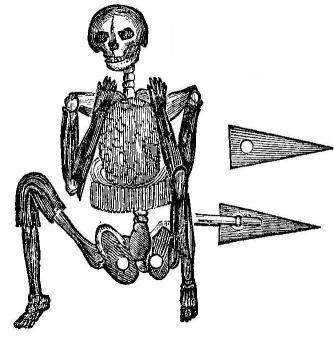 <-The
following sketch will give our readers an idea of the posture of the figure
and the position of the armor. When the remains were discovered, the arms
were brought rather closer to the body than in the engraving. The arrows were
near the right knee.
<-The
following sketch will give our readers an idea of the posture of the figure
and the position of the armor. When the remains were discovered, the arms
were brought rather closer to the body than in the engraving. The arrows were
near the right knee.
Considerable flesh is still preserved on the hands and arms, but none
on the shoulders and elbows. On the back, under the belt, and for two inches
above and below, the skin and flesh are in good pre-servation, and have the
appearance of being tanned. The chest is much compressed, but the upper viscera
are probably entire. "The arms are bent up, not crossed ; so that the
hands turned inwards touch the shoulders. The stature is about five and a
half feet. Much of the exterior envelope was decayed, and the inner one ap-
peared to be preserved only where it had been in contact with the brass.
The preservation
of this body may be the result of some embalming process; and this hypothesis
is strengthened by the fact, that the skin has the appearance of having been
tanned; or it maybe the accidental result of the action of the salts of the
brass during oxydation; and this latter hypothesis is supported by the fact,
that the skin and flesh have been preserved only where they have been in contact
with, or quite near, the brass; or we may account for the preservation of
the whole by supposing the presence of saltpetre in the soil at the time of
the deposit. In either way, the preservation of the remains is fully accounted
for, and upon known chemical principles.
That the body
was not one of the Indians, we think needs no argument. We have seen some
of the drawings taken from the sculptures found at Palanque, and in those
the figures are represented with breast-plates, although smaller than the
plate found at Fall River. On the figures at Palenque the bracelets and anklets
appear to be of a manufacture precisely similar to the belt of tubes just
described. These figures also have helmets precisely answering the description
of the helmet of Homer's (Greek phrase followed, font not available. ajb)
No. XX.
[REFERENCE FROM PAGE 499.]
WE the subscribers, having been requested to give our opinion with regard
to the religious and moral character of the late Capt. Joseph Brant, and the
state of his mind as it appeared to us at its dissolution-hereby declare,
that having lived a number of years a near neighbor of his, (our farms adjoining
the place of his residence,) we were intimately acquainted with him ; in conversation
he would often begin the subject, and dwell upon the duties that we owed one
to another. He was a believer in the Christian religion, and was brought up
in the doctrine of the Episcopal Church of England, of which he was a member
when he died. During his illness we were often with him, and were present
at his dissolution. During his sickness, (which was painful,) he was patient
and resigned, and appeared always thankful to his friends for the attention
paid to him. It is our opinion that during his sickness, and at the close
of it, he was possessed of his rational faculties, and that he lived and died
in the faith of the Christian religion.
AUGUSTUS BATES,
ASAHEL DAVIS.
Wellington Square, U. C.
August 16th, 1837.)
No. XXI.
[REFERENCE FROM PAGE 526.]
Letter to the Mohawk Chief Ahyonwaeghs, commonly called John Brant,
Esq. of the Grand River, Upper Canada.
London, January 20, 1822.
SIR,
Ten days ago I was not aware that such a person existed as the son of the
Indian leader Brant,* who is mentioned in my poem " Gertrude of Wyoming."
Last week, however, Mr. S. Bannister of Lincoln's Inn, called to inform me
of your being in London, and of your having documents in your possession which
he believed would change my opinion of your father's memory, and induce me
to do it justice. Mr. Bannister distinctly assured me that no declaration
of my sentiments on the subject was desired but such as should spontaneously
flow from my own judgment of the papers that were to be submitted to me.
I could not be
deaf to such an appeal. It was my duty to inspect the justification of a man
whose memory I had reprobated, and I felt a satisfaction at the prospect of
his character being redressed, which was not likely to have been felt by one
who had wilfully wronged it. As far as any intention to wound the feelings
of the living was concerned, I really knew not, when I wrote my poem, that
the son and daughter of an Indian chief were ever likely to peruse it, or
be affected by its contents. And I have observed most persons to whom I have
mentioned the circumstance of your appeal to me, smile with the same surprise
which I experienced on first receiving it. With regard to your father's character,
I took it as I found it in popular history. Among the documents in his favor
I own that you have shown me one which I regret that I never saw before, though
I might have seen it, viz. the Duke of Rochefoucault's honorable mention of
the chief in his travels.+ Without meaning, however, in the least to invalidate
that nobleman's respectable authority, t must say, that even if I had met
with it, it would have still offered only a general and presumptive vindication
of your father, and not such a specific one as I now recognize. On the other
hand, judge how naturally I adopted accusations against him which had stood
in the Annual Register of 1779, as far as I knew, uncontradicted for thirty
years. A number of authors had repeated them with a confidence
* The name has been almost always inaccurately spelt Brandt
in English books.
+ The following testimony is borne to his fair name by Rochefoucault, whose
ability and means of forming a correct judgment will not be denied. "Col.
Brant is an Indian by birth. In the American war he fought under the English
banner, and he has since been in England, where he was most graciously received
by the
King, and met with a kind reception from
all classes of people. His manners are semi-European. He is attended by two
negroes; has established himself in the English way ; has a garden and a farm;
dresses after the European fashion ; and nevertheless possesses much influence
over the Indians. He assists at present (1795) at the Miami Treaty, which
the United States are concluding with the western Indians, He is also much
respected by the Americans ; and in general bears w excellent a name, that
I regret I could not see and become acquainted with him."-
Rochefoucault's Travels in North America.
which beguiled
at last my suspicion, and I believe that of the public at large. Among those
authors were Gordon, Ramsay, Marshall, Belsham, and Weld. The most of them,
you may tell me, perhaps wrote with zeal against the American war. Well, but
Mr. John Adolphus was never suspected of any such zeal, and yet he has said
in his History of England, &c. (vol. iii. p. 110) "that a force of
sixteen hundred savages and Americans in disguise, headed by an Indian Col.
Butler, and a half Indian of extraordinary ferocity named Brant, lulling the
fears of the inhabitants (of Wyoming) by treachery, suddenly possessed themselves
of two forts, and massacred the garrisons." He says farther, " that
all were involved in unsparing slaughter, and that even the devices of torment
were exhausted." He possessed, if I possessed them, the means of consulting
better authorities; yet he has never to my knowledge made any atonement to
your father's memory. When your Canadian friends, therefore, call me to trial
for having defamed the warrior Brant, I beg that Mr. John Adolphus may be
also included in the summons. And after his own defence and acquittal, I think
he is bound, having been one of my historical misleaders, to stand up as my
gratuitous counsel, and say, " Gentlemen, you must acquit my client,
for he has only fallen into an error, which even my judgment could not escape."
In short, I imbibed
my conception of your father from accounts of him that were published when
I was scarcely out of my cradle. And if there were any public, direct, and
specific challenges to those accounts in England ten years ago, I am yet to
learn where they existed.
I rose from perusing
the papers you submitted to me certainly with an altered impression of his
character. I find that the unfavorable accounts of him were erroneous, even
on points not immediately connected with his reputation. It turns out, for
instance, that he was a Mohawk Indian of unmixed parentage. This circumstance,
however, ought not to be overlooked in estimating the merits of his attainments.
He spoke and wrote our language with force and facility, and had enlarged
views of the union and policy of the Indian tribes. A gentleman who had been
in America, and from whom I sought information respecting him in consequence
of your interesting message, told me that though he could not pretend to appreciate
his character entirely, he had been struck by the naivete and eloquence
of his conversation. They had talked of music, and Brant said, "I like
the harpsichord well, and the organ still better; but I like the drum and
trumpet best of all, for they make my heart beat quick." This gentleman
also described to me the enthusiasm with which he spoke of written records.
Brant projected at that time to have written a History of the Six Nations.
The genius of history should be rather partial to such a man.
I find that when
he came to England, after the peace of 1783, the most distinguished individuals
of all parties and professions treated him with the utmost kindness. Among
these were the late Bishop of London, the late Duke of Northumberland, and
Charles Fox. Lord Rawdon, now Marquis of Hastings, gave him his picture. This
circumstance argues recommendations from America founded in personal friendship.
In Canada the memorials of his moral character represent it as naturally ingenuous
and generous. The evidence afforded, induces me to believe that he often strove
to mitigate the cruelty of Indian warfare. Lastly, you affirm that he was
not within many miles of the spot when the battle which decided the fate of
Wyoming took place, and from your offer of reference to living witnesses,
I cannot but admit the assertion. Had I learnt all this of your father when
I was writing my poem, he should not have figured in it as the hero of mischief.
I cannot, indeed, answer by anticipation what the writers who have either
to retract or defend what they may have said about him, may have to allege
; I can only say that my own opinion about him is changed. I am now inclined
exceedingly to doubt Mr. Weld's anecdote, and for this reason:
Brant was not
only -trusted, consulted, and distinguished by several eminent British officers
in America, but personally beloved by them, Now I could conceive men in power,
for defensible reasons of state politics, to have officially trusted, and
even publicly distinguished at courts or levees, an active and sagacious Indian
chief, of whose private character they might nevertheless still entertain
a very indifferent opinion. But I cannot imagine high-minded and high-bred
British officers forming individual and fond friendships for a man of ferocious
character. It comes within my express knowledge that the late General Sir
Charles Stuart, fourth son of the Earl of Bute, the father of our present
Ambassador at Paris, the officer who took Minorca and Calvi, and who commanded
our army in Portugal, knew your father in America, often slept under the same
tent with him, and had the warmest regard for him. It seems but charity to
suppose the man who attracted the esteem of Lord Rawdon and General Stuart
to have possessed amiable qualities, so that I believe you when you affirm
that he was merciful as brave. And now I leave the world to judge whether
the change of opinion, with which I am touched, arises from false delicacy
and flexibility of mind, or from a sense of honor and justice.
Here, properly
speaking, ends my reckoning with you about your father's memory; but as the
Canadian newspapers have made some remarks on the subject of Wyoming, with
which I cannot fully coincide, and as this letter will probably be read in
Canada, I cannot conclude it without a few more words, in case my silence
should ; seem to admit of propositions which are rather beyond the stretch
of my creed. I will not, however, give any plain truths which I have to offer
to the Canadian writers the slightest seasoning of bitterness, for they have
alluded to me, on the whole, in a friendly and liberal tone. But when they
regret my departure from historical truth, I join in their regret only in
as far as I have unconsciously misunderstood the character of Brant, and the
share of the Indians in the transaction, which I have now reason to suspect
was much less than that of the white men. In other circumstances I took the
liberty of a versifier to run away from- fact into fancy, like a schoolboy
who never dreams that he is a truant when lie rambles on a holiday from school.
It seems, however, that I falsely represented Wyoming to have been a terrestial
paradise. It was not so, say the Canadian papers, because it contained a great
number of Tories ; and undoubtedly that cause goes far to account for the
fact. Earthly paradises, however, are not earthly things, and Tempe and Arcadia
may have had their drawbacks on happiness as well as Wyoming. I must nevertheless
still believe that it was a flourishing colony, and that its destruction furnished
a just warning to human beings against war and revenge. But the whole catastrophe
is affirmed in a Canadian newspaper to have been nothing more than a fair
battle, If this be the fact, let accredited signatures come forward to attest
it, and vindicate the innocence and honorableness of the whole transaction,
as your father's character has been vindicated. An error about him by no means
proves the whole account of the business to be a fiction. Who would not wish
its atrocity to be disproved ? But who can think it disproved by s single
defender, who writes anonymously, and without definable weight or authority
?
In another part
of the Canadian newspapers, my theme has been regretted as dishonorable to
England. Then it was, at all events, no fable. But how far was the truth dishonorable
to England? American settlers, and not Englishmen, were chiefly the white
men calling themselves Christians, who were engaged in this affair. I shall
be reminded, perhaps, that they also called themselves Loyalists. But for
Heaven's sake let not English loyalty be dragged down to palliate atrocities,
or English delicacy be invoked to conceal them. I may be told that England
permitted the war, and was
vol. II. 39
therefore responsible
for its occurrences. Not surely universally, not directly. I should be unwilling
to make even Lord North's ad ministration answerable for all the actions of
Butler's rangers; and I should be still more sorry to make all England amenable
either for Lord North's administration, or for Butler's rangers. Was the American
war an unanimous and heartfelt war of the people ? Were the best patriots
and the brightest luminaries of our Senate for, or against it ? Chatham declared
that if America fell she would fall like the strong man-that she would embrace
the pillars of our constitution and perish beneath its ruins. Burke, Fox,
and Barre kindled even the breasts of St. Stephen's chapel against it; and
William Pitt pronounced it a war against the sacred cause of Liberty. If so,
the loss of our colonies was a blessing, compared with the triumph of those
principles that would have brought Washington home in chains. If Chatham and
Pitt were our friends in denouncing the injustice of this war, then Washington
was only nominally our foe in resisting it; and he was as much the enemy of
the worst enemies of our constitution, as if he had fought against the return
of the Stuarts on the banks of the Spey or the Thames. I say, therefore, with
full and free charity to those who think differently, that the American war
was disgraceful only to those who were its abettors, and that the honor of
Englishmen is redeemed in proportion as they deprecate its principles and
deplore its details. Had my theme even involved English character more than
it does, I could still defend it. If my Canadian critic alleges that a poet
may not blame the actions of his country, I meet his allegation, and deny
it. No doubt a poet ought not for ever to harp and carp upon the faults of
his country ; but he may be her moral Censor, and he must not be her parasite.
If an English poet under Edward III had only dared to leave one generous line
of commiseration to the memory of Sir William Wallace, how much he would have
raised our estimation of the moral character of the age ! There is a present
and a future in national character, as well as a past, and the character of
the present age is best provided for by impartial and generous sentiments
respecting the past. The twentieth century will not think the worse of the
nineteenth for regretting the American war. I know the slender importance
of my own works. I am contending, however, against a false principle of delicacy
that would degrade poetry itself if it were adopted ;-but it never will be
adopted.
I therefore regret
nothing in the historical allusions of my poem, except the mistake about your
father. Nor, though I have spoken freely of American affairs, do I mean to
deny that your native tribes may have had a just cause of quarrel with the
American colonists. And I regard it as a mark of their gratitude that they
adhered to the royal cause, because the governors, acting in the king's name,
had been their most constant friends ; and the colonial subjects, possibly
at times their treacherous invaders. I could say much of European injustice
towards your tribes, but in spite of all that I could say, I trust still deplore
the event of Christians having adopted their mode of warfare, and, as circumstances
then stood, of their having invoked their alliance. If the Indians thirsted
for vengeance on the colonists, that should have been the very circumstance
to deter us from blending their arms with ours. I trust you will understand
this declaration to be made in the spirit of frankness, and not of mean and
inhospitable arrogance. If I were to speak to you in that spirit, how easily
and how truly could you tell me that the American Indians have departed faster
from their old practices of warfare, than Christians have departed from their
habits of religious persecution. If I were to preach to you about European
humanity, you might ask me how long the ashes of the Inquisition have been
cold, and whether the slave-trade be yet abolished ? You might demand, how
many-no, how few generations have elapsed since our old women were burnt for
imaginary commerce with the devil, and whether the houses be not yet standing
from which our great-grandmothers may have looked on the hurdles passing to
the place of execution, whilst they blessed themselves that they were not
witches! A horrible occurrence of this nature took place in Scotland during
my own grandfather's life-time. As to warlike customs, I should be exceedingly
sorry if you were to press me even on those of my brave old ancestors, the
Scottish Highlanders. I can, nevertheless recollect the energy, faith, and
hospitality of those ancestors, and at the same time I am not forgetful of
the simple virtues of yours.*
* Considering the filial motives of the young chief's appeal
to me, I am not afraid that any part of this letter, immediately relating
to him, will be thought ostentatious or prolix. And if charitably judged,
I hope that what I have said of myself and of my poem will not be felt as
offensive egotism. The public has never been troubled with any defences of
mine against any attacks on my poetry that were mere literary: although I
may have been as far as authors generally are from bowing to the justice of
hostile criticism. To show that I have not been over-anxious about publicity,
I must mention a misrepresentation respecting my poem on Wyoming which I have
Buffered to remain uncontradicted for ten years. Mr. Washington Irving, in
a biographical sketch prefixed to it in an American edition, described me
as having injured the composition of the poem by shewing it to friends who
struck out its best passages. Now I read it to very few friends, and to none
at whose suggestion I ever struck out a single line. Nor did I ever lean on
the taste of others with that miserable distrust of my own judgment which
the anecdote conveys. I know that
I have been thus
special in addressing you from a wish to vindicate my own consistency, as
well as to do justice to you in your present circumstances, which are peculiarly
and publicly interesting. The chief of an aboriginal tribe, now settled under
the protection of our sovereign in Canada, you are anxious to lead on your
people in a train of civilization that is already begun. It is impossible
that the British community should not be touched with regard for an Indian
stranger of respectable private character, possessing such useful and honorable
views. Trusting that you will amply succeed in them, and long live to promote
improvement and happiness amidst the residue of your ancient race,
I remain, your sincere well-wisher,
THOMAS CAMPBELL.
Mr. Irving was the last man in the world to make such a misrepresentation
intentionally, and that I could easily contradict it; but from aversion to
bring a petty anecdote, about my self before the world, I forbore to say any
thing about it. The case was different when a Canadian writer hinted at the
patriotism of my subject. There he touched on my principles, and I have defended
them, contending that on the supposition of the story of Wyoming being true,
it is a higher compliment to British feeling to reveal than to palliate or
hide it.
THE END